CDC Data Proves Teen Cannabis Use Dropped 44% After Legalization
Prohibitionists Aren’t Going to Like This One
For fifty years the argument against legal cannabis has had one load-bearing wall: “What about the children?” Every other objection, from traffic safety to potency, leans on it. So let me stack the data against it, and then tell you honestly where the data runs out, because it does.
The headline numbers
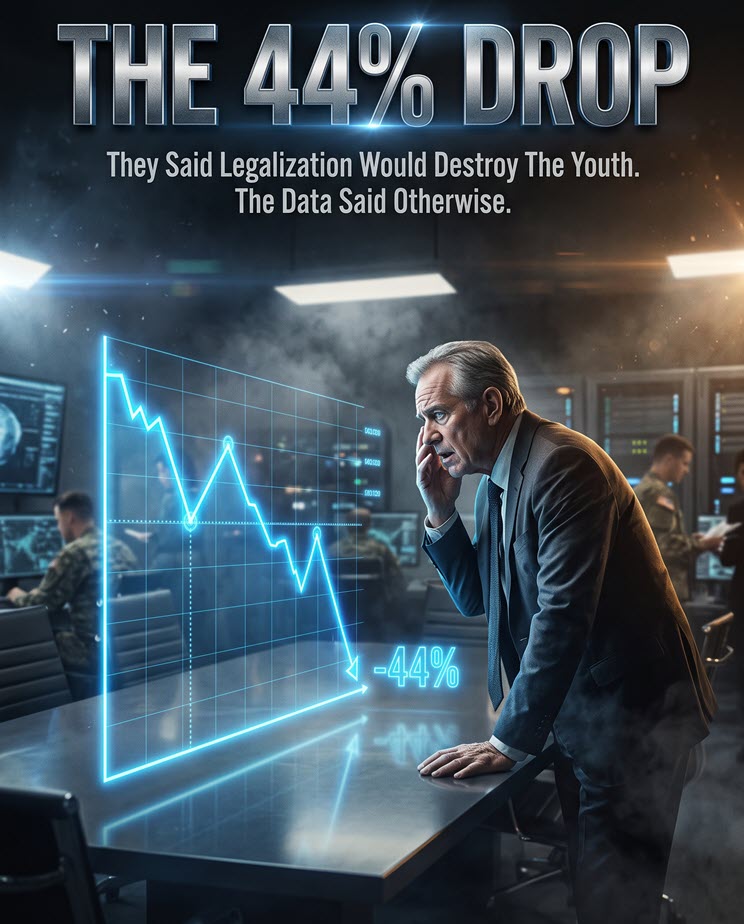
The CDC’s Youth Risk Behavior Survey, released September 21, 2026, found that 12.9% of U.S. high school students used cannabis in the past 30 days in 2025. In 2011 it was 23.1%. In 2023 it was 17.0%. That’s a 44% drop since 2011 and roughly a 24% drop in two years. Lifetime use fell from 39.9% to 25.5% over the same stretch. Over those same years, adult-use markets opened in state after state.
Monitoring the Future, the University of Michigan survey funded by NIDA, tells the same story. Past-30-day use from 2011 to 2025: 8th graders from 7.2% to 4.0%, 10th graders from 17.6% to 9.4%, 12th graders from 22.6% to 17.1%. The share of 12th graders calling cannabis “fairly or very easy” to get fell from 82.2% to 65.2%. And the federal household survey, NSDUH, has past-year use among 12-to-17-year-olds sliding from 10.9% in 2021 to 8.7% in 2025.
Three independent surveys, three methodologies, one direction.
The state-level picture
The Marijuana Policy Project’s October 2026 report, which NORML summarized, breaks it down by state:
-
Colorado (Healthy Kids Colorado): 22.0% in 2011, 9.7% in 2025.
-
Washington (12th graders): 26.7% in 2012, 11.7% in 2025.
-
Massachusetts: 24.5% in 2015, 12.0% in 2025.
-
Illinois: 20.8% in 2017, 8.2% in 2025.
-
Missouri: 16.7% in 2021, 8.5% in 2025.
Now the data prohibitionists will wave, and I’ll wave it for them. New York outside the city rose from 12.0% to 14.2% between 2023 and 2025. Rhode Island and Ohio both jumped in 2023 and fell back in 2025. Washington’s 12th-grade rate was flat through 2018 at 26.2% before dropping. Not every state produces a clean line.
One more caution on my own side’s math: NORML’s write-up describes Colorado and Washington 12th-grade declines as “over 60%” and “over 65%”. The MPP tables I checked work out to about 56% for each. That’s still enormous. I’ll use the number the table supports.
What the peer-reviewed work says
Surveys are descriptive; the studies try to isolate the law’s effect.
-
Anderson and colleagues, JAMA Psychiatry, 2024: more than 207,000 students through 2021, no evidence that recreational legalization encouraged teen use.
-
Coley and colleagues, JAMA Pediatrics, 2024: legalization and retail sales were not associated with increased adolescent use between 2011 and 2021, with modest decreases in alcohol and e-cigarette use. One wrinkle: retail sales were linked to lower odds of use but somewhat higher frequency among those who did use.
-
Anderson and colleagues, JAMA Pediatrics, 2019: an 8% decrease in teen use after legalization, a 9% drop in frequent use, across 1.4 million students.
-
Counterpoint: Cerdá and colleagues, 2017, found increases among 8th and 10th graders in Washington but not in Colorado. A 2024 meta-analysis in the Journal of the American Academy of Child and Adolescent Psychiatry found a modest positive association between recreational legalization and past-month use, mainly in young adults.
-
A rapid review of adolescent studies counted 10 with no change, 6 with decreases and 7 with increases. Two studies linked legalization to cannabis use disorder in adolescents.
The honest summary: the weight of evidence says legalization doesn’t produce a teen-use surge, and plausibly nudges it down. It does not say legalization is proven to reduce it. Teen use fell nationally, including in states that never legalized. The CDC’s 2011 to 2025 decline is partly a national trend, so “legalization caused the drop” is a claim these data can’t carry. “Legalization failed to cause the spike we were promised” is a claim they can.
Why the mechanism makes sense
There’s a plausible reason a regulated market might reduce youth access. A dealer doesn’t check ID. A licensed store does, and its license depends on it. Colorado’s drop in perceived and actual access is consistent with that, as is the MTF finding that fewer teens say cannabis is easy to get. Replacing an illicit market with a regulated one moves the point of sale from a stranger’s car to a counter with a camera and a compliance officer.
This is also the argument that’s hardest to take seriously from the other side. If prohibition protected kids, the 1990s and 2000s, with the harshest enforcement in history, should have been the safest years for teens. In 2011, before any state had opened a legal market, 23.1% of high schoolers were using.
What I won’t tell you
A few things the optimists skip.
First, the product changed. Flavored vaping is now the most common way teens use cannabis; NSDUH finds about 70% of teen past-month users vape. Hemp-derived intoxicating products, sold outside the licensed system in many places, show past-year use of about 2%, 6% and 9% among 8th, 10th and 12th graders. Those products are the gap in the regulated system, and kids are finding it.
Second, adults. MTF’s 2025 data show daily cannabis use among 19-to-30-year-olds at a record 11.8%, with past-30-day use at 29%. That is the other half of the thesis: more adults consume. Whether that’s a success depends on your values, and on whether the rising daily-use rate reflects substitution for alcohol or something more worrying.
Third, the CDC surveyed students in 2025 with instructions to exclude CBD and hemp products, and the proposed 2027 survey would drop that exclusion. The numbers may not stay this tidy.
Where the money goes
Adults buying legally is the reason there’s money in the story. States have collected a cumulative $28.4 billion in adult-use cannabis taxes through 2025, with a record $4.57 billion in 2025, according to MPP. The Census Bureau counted $3.55 billion in excise collections across 30 states and D.C. for the year ending June 2026. Industry trackers put cannabis employment around 425,000 to 445,000 full-time-equivalent jobs. Sales growth has stalled, though; Whitney Economics estimated regulated sales around $29 billion in 2025 and noted the first decline. Washington’s tax revenue peaked at $396 million. Tax receipts differ across trackers, so treat all of these as estimates.
The other side of the argument
Smart Approaches to Marijuana, the main national group opposing legalization, reads the data differently. Its 2026-27 Impact Report claims higher use and harms in legal states, and its 2019 rebuttal pointed to NSDUH data on rising youth use. Kevin Sabet’s position is that “These drugs aren’t safe and they aren’t medicine.” SAM Action also put roughly $1.55 million behind this year’s Massachusetts ballot question to repeal retail sales, which has 78,301 certified signatures; Massachusetts polling shows overwhelming opposition to repeal.
I’d welcome their response to the survey data above. If legal states really are seeing more teen use, the CDC, Monitoring the Future and NSDUH series should show it, and they mostly show the reverse.
The bottom line
Teen cannabis use has fallen across three national surveys while legal markets have opened. At worst, legalization has had no measurable effect on teen use; at best, it has helped. Either way, “what about the children?” doesn’t hold up as a reason to keep cannabis illegal. The honest next question is how to close the vape and hemp gaps. Legalization isn’t a magic fix for kids, but it’s doing no worse than the system it replaced, and it brings in tax revenue and jobs that prohibition never did.
Sources
- NORML, analysis of the Marijuana Policy Project report on teen use in legalization states, Oct. 1, 2026.
- CDC, Youth Risk Behavior Survey 2025 results, released Sept. 21, 2026.
- University of Michigan, Monitoring the Future 2025 panel results (NIDA-funded).
- SAMHSA, National Survey on Drug Use and Health, 2021-2025.
- Anderson et al., JAMA Psychiatry, 2024; Coley et al., JAMA Pediatrics, 2024;178(6):622-625; Anderson et al., JAMA Pediatrics, 2019; Cerdá et al., 2017; JAACAP meta-analysis, 2024.
- Smart Approaches to Marijuana, Impact Report 2026-27, learnaboutsam.org.
- Marijuana Policy Project and U.S. Census Bureau tax data; Whitney Economics; Vangst and Flowhub employment trackers.
TEEN MARIJUANA USE DROPS TO LOWEST LEVELS, READ ON…

TEEN MARIJUANA USE DROPS TO THE LOWEST LEVEL ON RECORD!

Cannabis Has a Water Activity Standard. Why Aren’t States Using It?
Comments are currently closed.