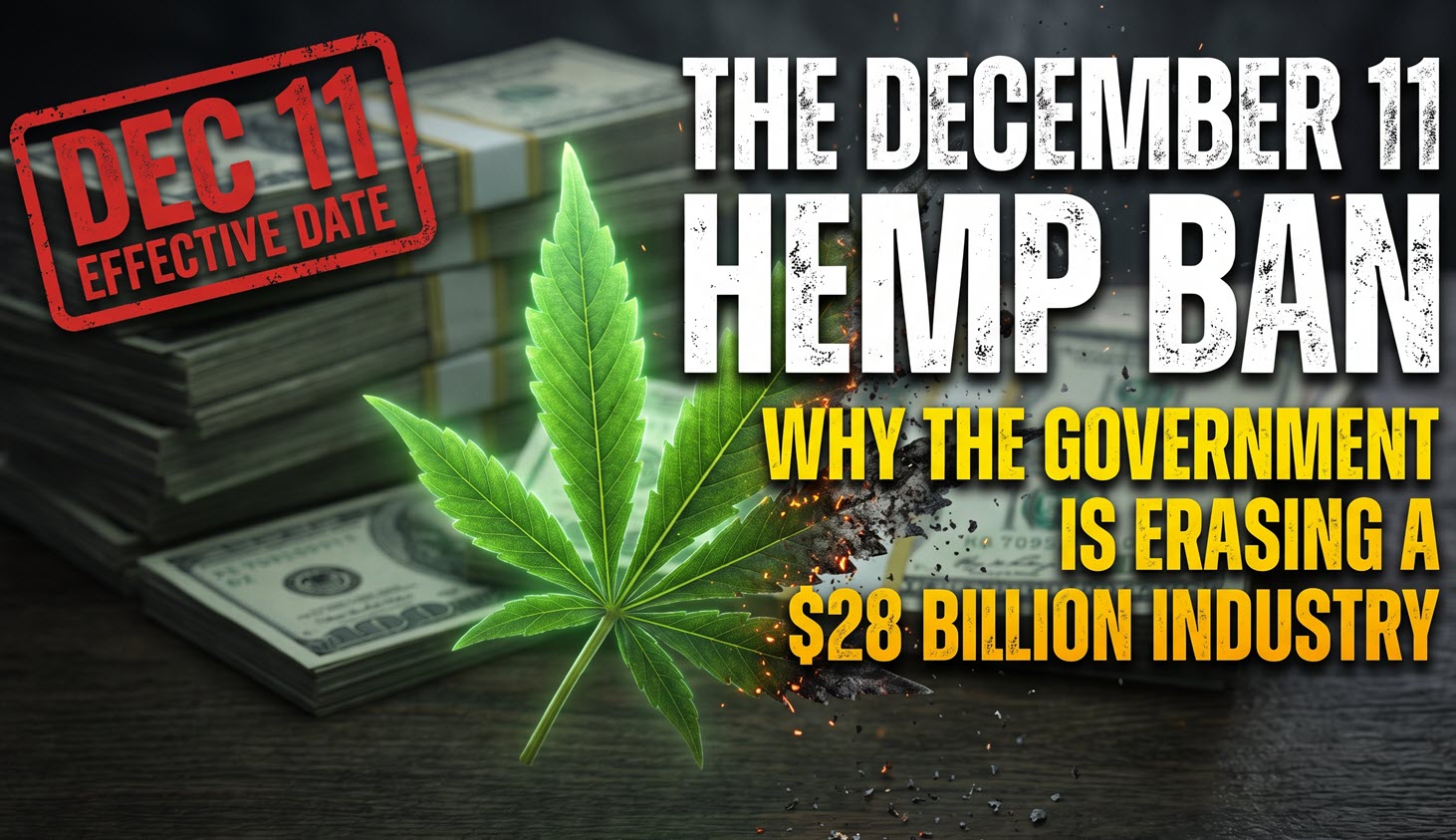
The December 11th Hemp Ban: Why the Government is Erasing a $28 Billion Industry
The War on Drugs, on Steroids: What Happens When We Ban a $28 Billion Industry
On December 11th, a very large chunk of the American economy is scheduled to become a federal crime, and almost nobody outside the hemp aisle seems to be talking about it.
Here is the setup. The 2018 Farm Bill legalized hemp, defined as cannabis with less than 0.3 percent delta-9 THC by dry weight. Clever chemists noticed that a gummy or a seltzer can meet that test and still get you properly high. A multibillion-dollar industry bloomed in the gap. Then, late last year, Mitch McConnell tucked a fix into the bill that ended the longest government shutdown in history. It caps hemp products at 0.4 milligrams of THC per container. Congress has since nudged the effective date from November 12 to December 11 for most products, with synthetic cannabinoids still losing hemp status on the original date, according to the AP and to law firm summaries of the delay.
How big is the blast radius? Industry analysts say roughly 95 percent of hemp-derived cannabinoid products on the market would become unlawful. A September report from Whitney Economics, cited by the AP, estimates the ban threatens $28.3 billion in retail revenue, 225,000 jobs and $2.1 billion in state sales tax potential. One caution on that headline number: the Marijuana Policy Project describes a similar $28 billion figure as tax revenue, while the AP frames it as retail sales. Those are different animals. I’m using the AP’s framing, and you should too.
So let’s run the scenario. What does the drug war playbook do when you point it at a legal market that has been selling to millions of adults?
First, a correction to my own premise
I’d love to tell you this puts us back in 1996, the year before California’s Proposition 215 cracked the federal wall. It doesn’t. State-licensed marijuana markets survive, and state-licensed medical cannabis moved to Schedule III this April by order of the Attorney General. This ban is something narrower and, in a way, weirder: 1980s enforcement logic aimed at the one slice of the cannabis economy that never had a state permission slip.
But the logic is the same, so it’s worth remembering what that logic produced. The Sentencing Project counts roughly 41,000 Americans locked up for drug offenses in 1980. By 2014 it was about 488,400. Marc Mauer put it at about 500,000 in 2009, which is more than the entire incarcerated population in 1980. In fairness, economist John Pfaff argues drug crime explains only around 20 percent of prison growth since 1980, so the drug war did not build mass incarceration alone. It did pack the buildings with people who had a baggie, a bong, or five grams of crack, which under the old mandatory minimums meant five years.
And what did we buy with all that? Drugs got cheaper, stronger and more compact. Which brings us to the sentence every prohibitionist hates: prohibition has never worked, and it keeps teaching us the same lesson in new chemistry.
Where does $28 billion go?
Money doesn’t vanish when you outlaw a product. It moves. Here’s my best accounting of where.
Licensed dispensaries in legal states. This is the quiet winner, which is why the state-legal industry lobbies for the ban. Lobbyist Cory Harris told the AP that the hemp market was built in a legally questionable loophole and that the sudden arrival of rules is a buzzkill the regulated industry has lived with for years. He also thinks the damage is overstated, since some hemp businesses could land in in-state markets. Fair. But dispensaries cannot serve North Carolina or the rest of the states with no legal market.
Alcohol. Total Wine and other alcohol retailers are defending hemp because THC seltzers have been offsetting falling booze sales. Ban the seltzer and that revenue flows back to a product the CDC links to about 178,000 deaths a year. Nobody is proposing to ban the drink with the bigger body count. Remember that when someone says this is about public health.
The illicit market. No bank, no tax authority, no lab report, no ID check. Nothing leaves consumers; demand just goes somewhere else.
Nowhere. A lot of it simply evaporates. The AP profiled Cornbread Hemp in Kentucky, with 105 employees, beverages in 18 states and a projected $65 million this year, whose owners say a 0.4 milligram cap means the place is toast. Another beverage company in Wisconsin has already mothballed production. In Rhode Island, one of the states that did it the grown-up way, regulated hemp sold $2.85 million in 2025, 83 percent of it drinks, through 201 licensed businesses. The state’s regulators say federal law forces them to enforce the new limit anyway, and liquor retailers warn that banks will stop processing the payments.
Who loses
Hemp farmers who bought seed on the promise of a market. Small processors who built compliance systems nobody asked them to build. Convenience stores, restaurants, and consumers in states with no legal program, who were buying federally legal products and now get to be criminals again.
There’s even a loser inside the federal government. The administration launched a Medicare program covering up to $500 a year of hemp-derived products, allowing up to 3 milligrams of THC per serving. The same government has a law capping a whole container at 0.4. Trump and OMB have urged Congress to fix this, at least for full-spectrum CBD. You can’t make this stuff up, and I’m a professional.
Run the scenario: 2026 edition
Now amplify it. The 1980s drug war ran on pagers, street corners and Colombian cargo planes. This one would run on a very different supply chain.
Overdose deaths in the US fell to about 70,000 in 2025, the CDC reports, down from a peak near 110,000 in 2022. That is the longest decline in decades, and naloxone and treatment get a lot of the credit. It is also fragile. Public health labs are tracking new synthetic opioids, including nitazenes, which UNODC says appeared in 29 countries’ markets in 2024 compared with 18 for fentanyl analogues. A Bellingcat investigation found more than 1,000 online ads for nitazenes, and the sellers matched companies on China’s corporate registry. UNODC also notes synthetic opioids sold sprayed on plant material or blotter paper, and a 2026 Brazilian study found nitazenes turning up in products containing synthetic cannabinoids.
Read that last bit twice. The moment you make real, labeled, tested THC illegal, you create demand for a substitute that’s cheaper to hide and easier to adulterate. That is the iron law of prohibition: enforcement selects for potency and compactness. A federal ban doesn’t stop people seeking a legal buzz; it nudges some toward whoever will sell them something that looks like it.
Where does AI fit? I’ll be careful, because I can’t prove anyone’s automated lab is running anywhere. What I can say is that the historic bottlenecks for pop-up operations were knowledge, marketing and evading screening, and modern language models and ad algorithms make all three cheaper. Treat that as a risk assessment, not a prophecy. But when the threat model includes translated listings, instant supplier research and thousands of near-identical storefronts, “just ban it” looks like bringing a clipboard to a drone fight.
And the cartels? I’ll push back on my own side here, because the lazy version of this argument (“the ban gives the cartels a payday”) overreaches. US legalization has already crushed much of the Mexican marijuana trade, with border seizures falling and cartels shifting toward heroin, meth and fentanyl. A hemp THC ban is not going to resurrect the 2009 weed economy. The more accurate claim is uglier: you re-open a mostly unregulated THC market to unlicensed operators, some of whom are already in the trafficking business, at the exact moment the illicit supply chain is full of potent synthetics.
Isn’t there a legitimate worry here?
Yes, and a good argument has to answer it. The AP describes hemp THC products turning up in gas stations where teens could buy them, untested and unlabeled. Attorneys general from 39 states pushed Congress to tighten the definition. Kevin Sabet of SAM says he has sympathy for people losing jobs but more for people harmed by the products. Those concerns are real.
But notice what the industry is asking for. Restrict sales to adults 21 and over. Cap potency per package. Ban imported cannabinoids. Add testing and labeling. Bills from Reps. Van Duyne and Landsman, Comer, and Barr would tax and regulate hemp THC more like alcohol. The National Restaurant Association wants a delay and a framework. Even the White House keeps asking Congress for changes. This coalition includes liquor retailers and trade groups never confused with a head shop.
I’ll also amend my own thesis. The hemp market proved that intoxicating hemp products can be sold legally. It did not prove that nothing bad happens when they’re sold with no rules, which is what the gas station era looked like. The narrower, stronger lesson: regulation beats both chaos and prohibition. Rhode Island’s licensed-retailer model is dull, which is the point.
The sticky bottom line
If Congress lets December 11th arrive untouched, we’ll have deleted a legal, taxable, job-creating market during an inflated, anxious economy, handed a chunk of it to alcohol and licensed dispensaries, pushed the remainder toward sellers with no lab reports, and done it while the drug supply gets more dangerous, not less.
So, do we really want the War on Drugs: On Steroids? I’d settle for the cheap, boring alternative the coalition already wrote: age gates, potency limits, testing, taxes. None of it has traction with leadership yet. That’s what the next eight weeks are for.
- AP via PBS NewsHour, “A $28 billion hemp THC industry is fighting to save itself from a looming federal ban”
- Marijuana Moment, “Marijuana Reform Group Asks Congress To Keep Hemp THC Products Legal”
- Marijuana Moment / Rhode Island Current, “Rhode Island Grapples With Hemp Policy As Federal Ban On THC Products Looms”
- Hemp Law Group, “Federal Hemp Law in 2026”
- PolitiFact, “How the war on drugs affected incarceration rates”
- The Sentencing Project, “The Changing Racial Dynamics of the War on Drugs” (2009)
- Reuters via MarketScreener, US overdose deaths fall in 2025 (CDC data)
- UNODC World Drug Report 2026, emerging opioid threats
- Bellingcat, “The Rise of Nitazenes”
- The Lancet Regional Health Americas, synthetic opioid contamination in Brazil (2026)
- InSight Crime, marijuana seizures at the US-Mexico border
- CDC, Deaths from excessive alcohol use
WHAT IS THE FEDERAL HEMP ACT, READ ON…
WHAT IS THE FEDERAL HEMP ACT? CLICK HERE!

Why Your Weed is Losing Potency While You Sleep (And How the Freezer Can Save It)
Comments are currently closed.