Why Prisons Should Give Inmates Weed to Stop the K2 Crisis – A Crazy Idea with Sane Numbers
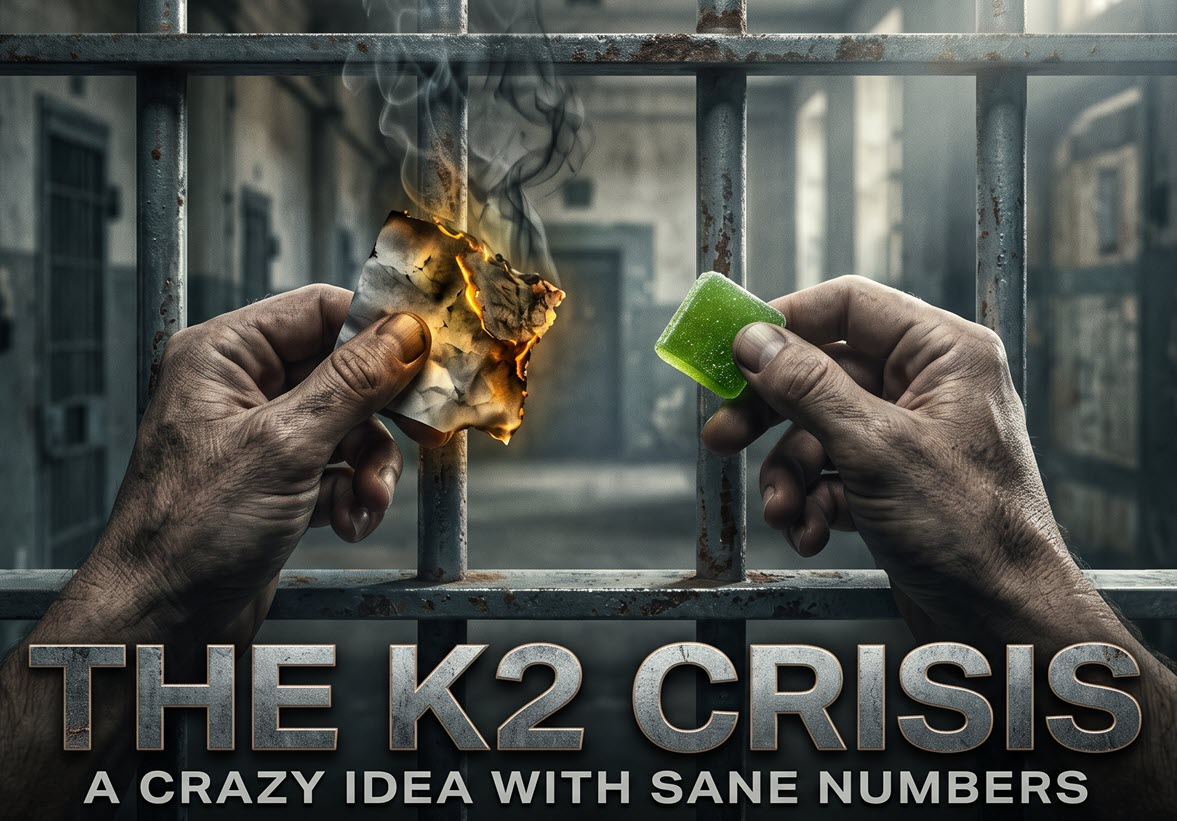

Pot for Prisoners: A Crazy Idea With Sane Numbers
Derek Jason LeCompte has been locked up in New Jersey for 27 years. In a recent essay for the Prison Journalism Project, republished by Marijuana Moment, he describes walking into his cell to find his cellmate babbling, eyes unfocused, the whole place reeking of burnt paper. LeCompte spent half an hour monitoring him, partly to make sure he didn’t die and partly to make sure he didn’t attack anyone while too far gone to know what he was doing.
That scene has become routine. The culprit is K2, a synthetic cannabinoid sprayed onto paper and smoked. Never in his 27 years, LeCompte writes, has he seen a substance this unregulated, this widely used and this dangerous.
His proposal sounds like a stoner’s fever dream: let incarcerated people have organic marijuana, in edible form, under rules. I’m a cannabis writer, so you’d expect me to cheer. I’ll do something more useful. I’ll check whether the idea survives contact with the evidence, and where it breaks, I’ll say so.
The problem is real, and prohibition made it
Nobody keeps a comprehensive national count of K2 deaths in prison. The numbers that exist are alarming. LeCompte cites Texas Observer reporting that K2 deaths in Texas prisons rose from 16 in 2023 to 65 in 2024, and Marshall Project reporting that Ohio’s went from three to 13 over the same stretch. Florida attributed a large share of 62 accidental deaths in 2016 and 2017 to K2.
Why K2 and not weed? Because prison is the purest prohibition laboratory we have. Total control, constant searches, restricted mail, restricted visits, restricted packages. And K2 is still everywhere, for precisely the reasons the iron law of prohibition predicts. A few drops of liquid on paper beat detection systems. A tiny amount is potent. The chemistry keeps shifting, so there’s no simple test. Plant cannabis is bulky, smelly and easy to catch, so it loses the competition to the stuff that is cheap to hide and hits harder. We built an incentive structure that selects for the worst drug available, then acted surprised when that’s what showed up.
LeCompte also reports that the corrections department’s restrictions on mail, visitation and packages haven’t worked. K2 remains abundant.
What the evidence actually supports
Substitution is plausible. A 2022 Washington State University study found a 37 percent drop in poison reports for illicit synthetic cannabinoids in states that had legalized marijuana. That’s a population-level correlation, not a prison trial, so I wouldn’t tattoo it on anything. But it points the way you’d expect: give people a safer option and fewer end up in the ER from the dangerous one.
Harm reduction has done this inside prison walls before, with other substances. LeCompte points to commissary vape pens as an alternative for smokers and Suboxone in some jails. A review from the Open Society Foundations found that prison needle exchange programs in Germany, Switzerland and Spain stopped the spread of disease without an increase in drug use. Edibles also solve a few practical problems: no smoke, no fire (LeCompte describes a K2 fire that nearly killed a man and his cellmate), no foul smell for officers working the tier.
Some staff are open to it. LeCompte talked with nine staff members of varying ranks, none willing to be named. More than half were generally in favor, for different reasons: reduced overdoses, a lighter workload, less suffering. This is a tiny, anecdotal sample, and I’m presenting it as exactly that.
Where I pump the brakes
The pitch I started with was bigger than the evidence, so let me edit myself.
“Chill the people out and violence drops.” Maybe, but I can’t hand you a study that shows it. The more defensible mechanism is not sedation. It’s removing the unpredictable psychosis, overdoses and debt-fueled violence that come with the K2 economy. LeCompte himself concedes that large numbers of heavily sedated people raise their own safety questions, and that “green-outs” (severe paranoia and anxiety episodes) would be hard for regular staff to manage.
PTSD. This is where the enthusiasm outruns the science. VA-funded systematic reviews in 2017 found insufficient evidence that cannabis helps PTSD, and one of the larger observational studies they examined found small but significant worsening among veterans who continued or started using. A 2026 scoping review of 26 studies reached the same conclusion, noting that most randomized trials showed no benefit over placebo. Trauma-focused therapy has the evidence. Cannabis, for now, doesn’t. Pain is a little better: low-strength evidence for neuropathic pain, insufficient for most others.
Prisoners growing it. I love the symmetry, but it’s the weakest part of the plan. Any cannabis produced inside the walls becomes currency, leverage and a power base for whichever group controls it. It also risks becoming one more form of unpaid or underpaid labor dressed up as empowerment. I’d supply a regulated, dose-limited product from a licensed vendor and keep cultivation out of the yard.
Grow the tomatoes instead
Here is the part of your idea with an evidence base: let them grow food and gardens. A systematic review of prison gardening programs found improved self-efficacy and self-worth, reduced anxiety and lower recidivism among participants. A Texas study found horticultural community service associated with the lowest recidivism of all categories examined. Programs like the Insight Garden Program run in several California prisons, and Notre Dame’s Lab for Economic Opportunities is running what it calls the first randomized controlled trial of an ecotherapy program in a US prison.
Caveat: participants often self-select, and researchers themselves note that comparing recidivism rates doesn’t prove causation. But for a program that costs next to nothing and gives people something to do with their hands, the case is strong. Organic food, outdoor work, a skill that transfers to a job.
How you’d actually test it
If I ran a state corrections department and wanted to know whether this works, I would not launch it systemwide. I’d do this:
- Pick a state where adult-use or medical cannabis is already legal, and one facility or housing unit.
- Source dose-capped edibles from a licensed vendor, with medical oversight and clear rules on when and how much.
- Track what matters: K2 overdoses and hospital transports, assaults, disciplinary infractions, contraband seizures and staff injuries, against a comparison facility.
- Hire an independent evaluator, and write a sunset clause so the pilot ends unless the numbers justify it.
- Pair it with real treatment. LeCompte is right that harm reduction doesn’t touch root causes the way mental health and substance use care do, and prisons don’t provide enough of either.
The legal terrain is easier than it used to be. Edibles don’t implicate federal smoking rules, and the Justice Department moved state-licensed medical marijuana to Schedule III in April. Federal prisons are a harder lift. State systems in legal states are the obvious place to start.
The bigger idea: ownership
Strip away the edibles and what’s left is the part I care about most. A prison that treats people as problems to be contained produces people who are, shockingly, still problems. A prison built around work, health care, therapy and some control over your own body and routine gives people something to practice for the outside. If the sentence is supposed to be about paying a debt, then paying it should leave you more capable than when you walked in, with food skills, a trade, treatment for the addiction that probably got you there, and a record of showing up. Not every crime is alike, and nobody serious thinks every inmate qualifies for every program. But a system that measures success by how long it can keep someone from touching a plant, and then releases them with no job, no treatment and a felony, has defined success wrong.
Who loses
The contraband economy, obviously. The people moving K2 into prisons make money from the prohibition you’re trying to route around. Some officers and some voters will also object on principle: LeCompte acknowledges that staff who see prison purely as punishment will oppose any version of this. Politicians fear the headline “State Gives Inmates Weed.” Fair enough. The counter-headline is “State Cuts Prison Overdose Deaths.”
The sticky bottom line
I came into this wanting a world where prisons reform people rather than just punish them. (Okay, punish them a little. They’re prisons.) That’s a legitimate goal, and “prohibit everything harder” has failed on its own terms: K2 is still abundant and still killing people.
So the idea isn’t crazy. It’s unfinished. Replace the wild parts (inmate-run grow rooms, miracle cures for PTSD, a prison full of blissed-out inmates) with a measured pilot, real treatment, gardens and honest data. If the numbers show fewer deaths, the argument makes itself. If they don’t, we should say so out loud, and that is the part I’d most like this movement to learn.
WHAT IS K2? READ ON..
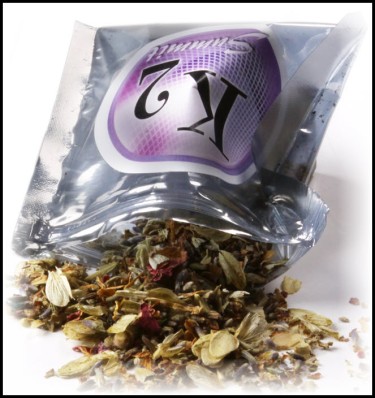
WHAT IS K2 AND WHY IS IT RUINING THE PRISONS?

The December 11th Hemp Ban: Why the Government is Erasing a $28 Billion Industry
Comments are currently closed.