Should You Be Feeding Your Cannabis Plants Baker’s Yeast? Here’s What the Science Actually Supports
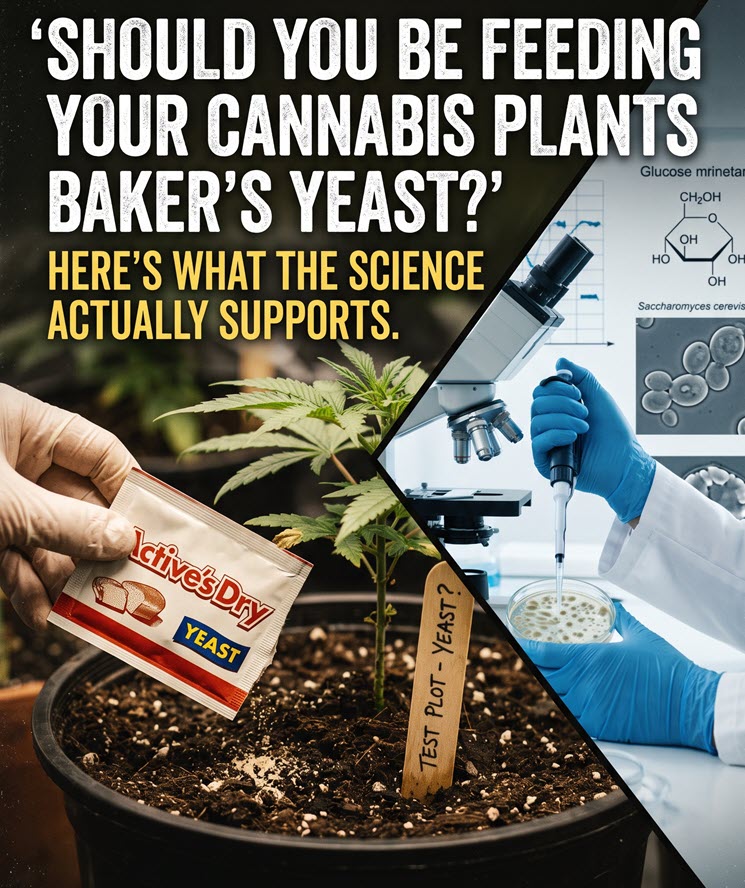
Green Avenger Seeds published a piece this week making the case for beneficial yeasts, specifically Saccharomyces, as an underused tool in cannabis cultivation, complete with drench recipes, foliar spray schedules, and a promise of denser trichomes and louder aroma. It’s a well-written piece of grower content, and credit to them for putting a genuinely underdiscussed microbe on people’s radar. But it’s also the kind of article that mixes real, citable plant science with the softer language of grower folklore — “studies show,” “growers report,” “one grower I know” — without pointing to a single study or naming a single source. That gap is worth closing before anyone dumps yeast into their reservoir. So let’s separate what’s documented from what’s marketing, and figure out whether this belongs in your regular rotation or stays a curiosity.
Start with the part that actually holds up under scrutiny, because there’s more of it than I expected going in. A growing body of peer-reviewed research on plant growth-promoting yeasts, PGPY in the literature, documents that Saccharomyces cerevisiae and related species genuinely do the things Green Avenger describes — just not in cannabis specifically. Studies published in journals including the World Journal of Microbiology and Biotechnology, FEMS Microbiology Letters, and the Journal of Pure and Applied Microbiology confirm that S. cerevisiae solubilizes phosphate and zinc by excreting organic acids that lower pH in the root zone, freeing up minerals that would otherwise stay chemically locked to calcium or iron. Separate research out of Frontiers in Plant Science and a Spanish-vineyard yeast survey published in Microbiological Research found the same yeast species producing indole-3-acetic acid, a natural auxin that drives root development, alongside measurable increases in seedling vigor in horticultural trials. None of that is fringe science. It’s a real, if still maturing, subfield of agricultural microbiology.
The pathogen-suppression claim checks out too, mechanistically. Yeasts genuinely do produce chitinases, enzymes that degrade the chitin in fungal cell walls, and they do compete aggressively with other microbes for leaf-surface real estate and sugar, a phenomenon researchers call competitive exclusion. That’s a documented mode of biocontrol used against postharvest fungal pathogens in fruit crops, and it’s plausible it works similarly against powdery mildew on cannabis leaves, though I want to flag the word plausible carefully, because plausible is not the same as proven in this specific plant.
Here’s the honest problem: every study I could verify involves grapes, maize, citrus, soybeans, cassava, or generic horticultural seedlings. I could not locate a single peer-reviewed, controlled trial testing Saccharomyces specifically on Cannabis sativa. That doesn’t mean it wouldn’t work — cannabis shares the same basic root and leaf biology as any other flowering plant — but it does mean every claim about “cannabis growers report” or “buds finish denser” is running on cross-crop extrapolation and grower anecdote, not cannabis-specific data. Green Avenger’s article does the same thing every cannabis cultivation blog does with novel biostimulants: it borrows credibility from real agricultural science, then quietly slides into unsourced claims about cannabis outcomes specifically.
The “14 to 56 percent dry bud weight gains” figure the article cites for commercial yeast extracts deserves its own callout, because I traced it. That range comes from marketing material for a commercial product line called Thrivedo, built around a heat-shocked Saccharomyces extract paired with a proprietary delivery technology the manufacturer calls OpusMAX. It’s a real product with a real company behind it, but the number comes from the manufacturer’s own promotional statements, not a published, peer-reviewed, independently replicated trial with disclosed sample sizes, controls, or statistical methods. That doesn’t make it false. It makes it unverified, and there’s a meaningful difference between those two things, especially when a number gets repeated across grower blogs until it starts sounding like settled fact.
For most growers, right now, I’d call this an interesting, low-cost side experiment rather than something you need to build your program around. Here’s my reasoning, laid out plainly rather than dressed up as encouragement either way. The underlying mechanisms — phosphate solubilization, auxin production, competitive exclusion against pathogens — are real and reasonably well-established in plant science broadly. The cost and risk of trying it are genuinely low: baker’s yeast is cheap, widely available, and food-grade safe. But the specific, cannabis-tailored outcomes the marketing promises — denser trichomes, “louder gas,” meaningfully higher dry yield — are not yet backed by controlled cannabis trials you or I can go read. You’d be testing an extrapolation, not applying an established protocol.
That combination — plausible mechanism, low downside, unproven cannabis-specific magnitude — is exactly the profile of something worth a small personal trial and a poor candidate for wholesale program adoption. If you’re running a commercial operation with tight margins and consistency requirements, I would not swap out a working nutrient program for an unverified biostimulant based on a blog post, however well-written. If you’re a home grower with a few plants and some curiosity, this is precisely the kind of low-stakes experiment cannabis cultivation is good for.
One thing the source article underplays: yeast drenches and foliar sprays introduce sugar and moisture into environments where cannabis is already notoriously vulnerable to botrytis, bud rot, and powdery mildew, especially in dense, high-humidity flower canopies. Green Avenger’s own piece tells you to stop foliar applications once buds get dense, which is the correct call, but it’s worth understanding why: a sugar-rich foliar mist landing on a tight, poorly-ventilated cola is a reasonable way to invite the exact mold problems you’re trying to prevent, if airflow and humidity control aren’t already dialed in. Yeast competing with pathogens for resources is the argument for using it; yeast providing pathogens more food and moisture is the argument for being careful about when and how. Both things can be true depending on your environment.
Treat this like an actual experiment, not a blanket new habit, and you’ll get a real answer instead of a vibe.
Run a controlled comparison, not a program-wide switch. Take clones or seeds from the same strain and pack, split them into a treated group and an untreated control, and change only the yeast variable. Keep every other input — light, nutrients, watering schedule — identical between groups.
Keep the dose conservative. A soil drench of roughly one teaspoon of active dry baker’s yeast, dissolved in a liter of lukewarm, non-chlorinated water with a small amount of unsulfured molasses to feed it, applied once every ten to fourteen days during vegetative growth, is a reasonable, low-risk starting point. For foliar applications, cut that concentration by roughly three-quarters, spray in the evening or during lights-off to avoid cooking sugars onto the leaf under heat, and stop entirely once flowers start packing in tight.
Track outcomes you can actually measure, not just vibes. Final dry weight per plant, time to harvest, any mold or mildew incidents, and if you want to get serious, send a sample from each group to a testing lab for cannabinoid and terpene analysis. “Louder gas” is a great marketing phrase and a useless data point.
Watch your reservoir if you’re in hydro. A living yeast culture in a closed loop can bloom unpredictably. Shorter contact windows, lower concentrations, and closer monitoring for cloudiness or pH swings are the difference between a helpful microbe and a fouled reservoir.
Give it real time before judging. Two to three weeks is the minimum window the underlying plant-microbiology research uses to detect a response in root and shoot development. Judging after a few days tells you nothing.
Beneficial yeast in cannabis cultivation is a legitimate scientific idea borrowed correctly from real agricultural microbiology and then extended, without direct evidence, into cannabis-specific marketing claims. The mechanism is credible. The cannabis-specific magnitude is not yet proven. That makes it worth a careful, controlled experiment for the curious home grower, and premature to treat as an established best practice for anyone running a commercial room. Test it in a corner of your grow before you test it on your whole harvest.
Source credit: Green Avenger Seeds, “Beneficial Yeasts for Cannabis: Enhancing Plant Health and Flavor with Saccharomyces,” published August 24, 2026, greenavengerseeds.com. Additional science referenced: World Journal of Microbiology and Biotechnology; FEMS Microbiology Letters; Journal of Pure and Applied Microbiology; Frontiers in Plant Science; Microbiological Research (Fernandez-San Millan et al., 2020); MMJDaily coverage of Thrivedo/OpusMAX yeast-extract marketing claims.
HIGH ON YEAST, READ ON…

ARE YOU GETTING HIGH OFF YEAST? READ THIS!

What Cannabis Manufacturers Can Learn from the Pharmaceutical Industry About Trace Metal Impurities in Plastic Materials Slang Drug Combinations – Candy Flips, Speedballs, and the Secret Language of Mixing
Comments are currently closed.