The End of the ‘Wine Mom’: Why Millions of Parents Are Trading Alcohol for Cannabis
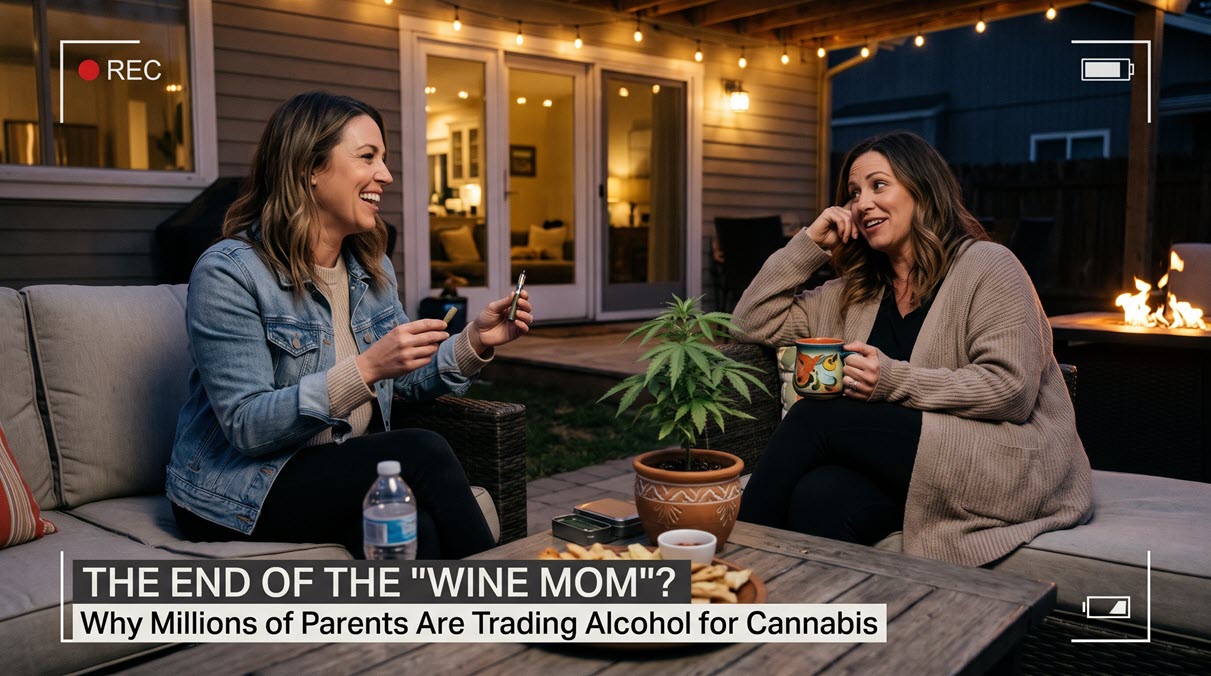
Picture the scene. It’s 8:47 p.m. The toddler has finally surrendered after a negotiation that would have exhausted a UN envoy. The kitchen looks like a small, sticky hurricane passed through. A children’s song you have now heard 340 times is still looping in your skull. And then, quietly, a parent steps onto the back porch, lights a small bowl, and exhales for what feels like the first time all day.
That parent is no longer an outlier. They’re a trend.
A new study from researchers at the University of California, San Diego, published in Addictive Behaviors and covered by KTVU, found that cannabis use among American parents rose substantially between 2012 and 2024. By 2024, 8% of parents used cannabis on most days and 5.2% used it daily. The researchers estimate at least 5.9 million U.S. children were living with a parent who used on most days. Perhaps most striking, daily cannabis use among parents was about four times as common as daily alcohol use.
So the pot parent has arrived. The more interesting question is why.
A generation that grew up with the plant
Start with who today’s parents actually are. Someone who was 16 in the year 2000 is about 42 now. Someone who was 16 in 2010 is about 32. Between them, that’s a big slice of the parents raising kids today, and their teenage years overlapped with a period when cannabis was everywhere.
It’s worth getting the history right, though, because the popular version is a little off. Teen cannabis use in the U.S. did not peak around 2000. According to the University of Michigan’s long-running Monitoring the Future survey, annual use among high school seniors peaked back in 1979 at 51%, fell to 22% by 1992, then surged again through the 1990s, peaking in 1996 and 1997. Use eased through the mid-2000s, then climbed again after 2006 or so.
So the kids of the late ’90s and early 2000s came of age right after a sharp resurgence, not at an all-time high. What matters more than the exact peak is what came with it. MTF researchers noted that teens’ perception of cannabis as risky started falling before use rose in the 1990s. This was the generation that sat through D.A.R.E. assemblies, watched the frying-egg PSAs, and then noticed that the classmates who smoked weed seemed mostly fine. Research later backed up their suspicion that the messaging wasn’t working: a 2004 study in the American Journal of Public Health found D.A.R.E. had no meaningful long-term effect on drug use.
When the official story doesn’t match what you see with your own eyes, you stop trusting the official story. That skepticism didn’t evaporate when this generation had kids. Many of them simply don’t carry the moral weight their own parents attached to cannabis. To them, it was never the devil’s lettuce. It was something half the people they knew had tried, and life went on.
Then came legalization. Medical cannabis spread through the 2000s, and recreational markets opened in Colorado and Washington in 2014. Today’s parents watched cannabis move from the back of a friend’s car to a well-lit storefront with a loyalty program. That shift in legal status reshaped social acceptability in a way no PSA ever could.
The alcohol comparison
The second driver is risk perception, and here today’s parents have some data on their side.
Alcohol remains one of the most harmful substances in common use. A 2015 analysis in Scientific Reports by Dirk Lachenmeier and Jürgen Rehm compared the margin of exposure, essentially the gap between typical use and a toxic dose, across common drugs. Alcohol came out as the highest-risk substance at the population level. Cannabis came out as the lowest risk of the substances studied. Unlike alcohol, there is no known lethal overdose of cannabis in adults.
Parents notice the difference in daily life too. Three glasses of wine tend to make most people sloppy, sleepy and slower to react, followed by a rough morning with kids who wake up at 6 a.m. regardless. Many parents report that a modest amount of cannabis lets them unwind without that same fog or hangover.
That is a reasonable comparison to make. But “less risky than alcohol” is not the same as “risk-free,” and I’ll come back to that, because the same study has some numbers parents shouldn’t skip.
Parenting is a stress test
The third reason is the one every parent understands in their bones. Raising kids is relentlessly demanding.
In 2024, U.S. Surgeon General Vivek Murthy issued an advisory specifically on parental mental health. It cited survey data showing 48% of parents say that on most days their stress is completely overwhelming, compared with 26% of other adults. Sleep deprivation, financial pressure, the logistics of work and childcare, and the low-grade sensory assault of a house full of small humans all add up.
This is where cannabis fits. The endocannabinoid system helps regulate stress, mood, sleep and pain, and many adults use cannabis for exactly those reasons. A parent who can’t fall asleep, has a back that aches from carrying a 30-pound child, or simply needs to come down from a day of constant vigilance has an obvious motive.
There’s also a cultural piece. For decades, “wine mom” culture was treated as a harmless punchline, with mugs and t-shirts to match. Cannabis offers a similar ritual: a moment at the end of the day that belongs to you. For many parents, it’s not about getting wrecked. It’s about getting back to baseline.
Where honesty requires a pause
I write about cannabis because I think it has been unfairly demonized for a century. That’s precisely why I’m not going to pretend this trend comes without real concerns. Being objective means taking the uncomfortable parts seriously too.
Impairment is impairment. THC affects attention, memory, coordination and reaction time. Feeling present and being fully responsive in an emergency are not the same thing. A parent who has had a small amount after the kids are asleep is in a very different position than one who is high while supervising a toddler near a pool. Dr. Jarid Pachter of Stony Brook Medicine, who wasn’t involved in the study, made this point well: the concern isn’t whether cannabis users can be good parents, it’s being impaired when you’re responsible for a child’s safety.
Daily use carries its own risks. The UCSD study found 6.7% of parents met the criteria for cannabis use disorder. That’s not a rounding error. The more frequently someone uses, the higher that risk climbs, and nationally the habit is intensifying. A 2024 study by Jonathan Caulkins of Carnegie Mellon University, published in Addiction, found that daily or near-daily cannabis users outnumbered daily or near-daily drinkers in the U.S. for the first time in 2022, at about 17.7 million versus 14.7 million. A nightly bowl that started as a way to unwind can quietly become something you can’t go without.
Edibles and kids are a genuine danger. A 2023 study in Pediatrics found that reports to U.S. poison control centers of children under 6 eating cannabis edibles rose from 207 in 2017 to 3,054 in 2021, an increase of about 1,375%. To a three-year-old, a THC gummy looks exactly like a regular gummy. Because children weigh so little, even a single piece can mean a heavy dose. Some end up sedated, confused or hospitalized.
Smoke is still smoke. Cannabis smoke contains many of the same harmful combustion byproducts as tobacco smoke, and children can absorb THC through secondhand exposure. The long-term effects are still being studied, which is a reason for caution, not reassurance.
It’s also worth noting what the UCSD study did not show. The researchers didn’t measure parenting quality or children’s health, so the data doesn’t prove that parental cannabis use harms kids. It relied on self-reports, which can be skewed in either direction. Growing social acceptance may also make parents more willing to admit use they would have hidden in 2012.
A responsible pot parent’s playbook
If you’re a parent who uses cannabis, or you’re thinking about it, a few principles separate responsible use from reckless use:
-
Lock it up. Store all cannabis, especially edibles, in a locked container out of children’s reach. Not a high shelf. Locked.
-
Keep it away from the kids. Don’t smoke or vape around children, in the car, or inside the home. Go outside, away from open windows.
-
Separate use from caregiving. Use only when another sober adult is responsible for the children, or after they’re asleep and you won’t need to drive or respond to an emergency.
-
Watch the frequency. If you’re using every day, ask yourself honestly whether you could stop, and whether it’s affecting your sleep, work, relationships or patience.
-
Know the emergency plan. If a child eats an edible, call Poison Control at 1-800-222-1222 in the U.S., or 911 if they’re very drowsy or having trouble breathing.
The bottom line
The rise of the pot parent makes sense. Today’s parents grew up skeptical of drug-war messaging, came of age as legalization spread, understand that alcohol carries serious risks of its own, and are dealing with some of the highest parenting stress on record. For many of them, cannabis is a legal, lower-risk way to decompress at the end of an exhausting day.
But the same data that explains the trend also defines its limits. Responsible use means using in a way that never compromises a child’s safety, keeping products locked away, and paying attention to whether a nightly ritual is becoming a dependency. Cannabis can help a tired parent find their way back to baseline. It shouldn’t become the thing their kids need protecting from.
The pot parent isn’t a scandal. It’s a reflection of a generation that changed its mind about a plant. The challenge now is to prove that changing our minds also made us wiser about how to use it.
Sources
- Marijuana use rises sharply among one group of Americans, new study finds, KTVU/Fox News
- Monitoring the Future trends summary, via Drug Policy Facts
- Monitoring the Future 1975–2007, Volume I (OJP)
- West & O’Neal, Project D.A.R.E. outcome effectiveness revisited, American Journal of Public Health (2004)
- Lachenmeier & Rehm, Comparative risk assessment of alcohol, tobacco, cannabis and other illicit drugs, Scientific Reports (2015)
- U.S. Surgeon General’s Advisory on the Mental Health and Well-Being of Parents (2024)
- AP: Daily marijuana use outpaces daily drinking in the US (Caulkins, Addiction 2024)
- Pediatric edible cannabis exposures and acute toxicity: 2017–2021, Pediatrics, via Contemporary Pediatrics
ARE WEED MOMS THE NEW WINE MOMS? READ ON…

WHAT IS A WINE MOM IS SHE IS NOW GOING TO CANNABIS?

What Wine and Tobacco Know About Their Consumers That Cannabis Does Not
Comments are currently closed.