What is Aura Farming? – The Stoners Grew up and Now Their Kids are Aura Farming around the World
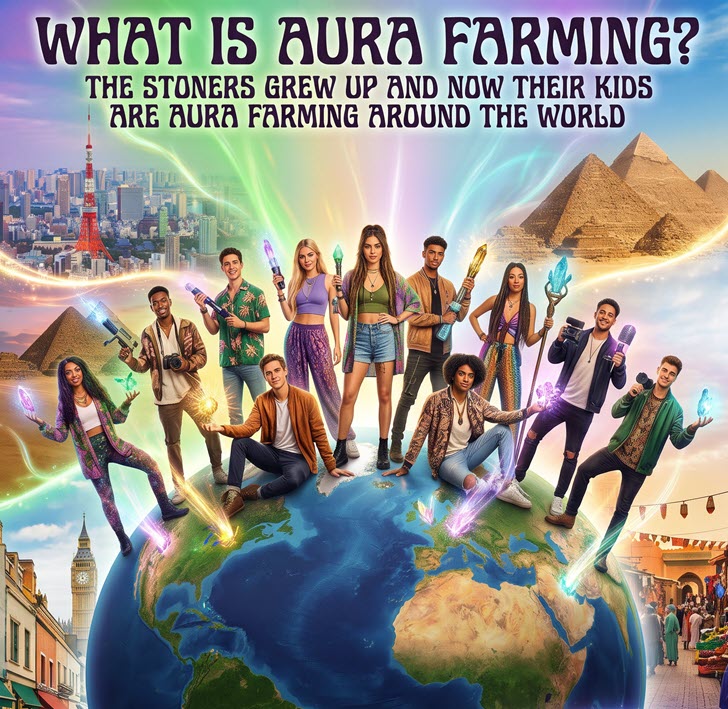
The Stoners Grew Up, and Their Kids Are Doing Something Called “Aura Farming”
Somewhere in America right now, a 42-year-old parent is packing a bowl in the garage after the kids go to bed, the same way they did in a dorm room twenty years ago. Meanwhile, upstairs, their teenager is standing perfectly still in a school hallway, staring down a classmate, about to launch into a silent, deadpan dance battle inspired by a meme about a basketball player’s height. Neither one has any idea what the other is doing, and I’d argue that’s the most interesting generational split happening in America right now.
Gallup released new polling data this week showing that 25 percent of adults between 30 and 49 now say they smoke marijuana, more than any other age group measured. Overall, 17 percent of all U.S. adults report smoking cannabis, more than double the rate Gallup recorded in 2013, before any state had legalized recreational use. Only 11 percent of adults still say they smoke cigarettes. For the first time in the history of this polling, weed has definitively out-smoked tobacco.
Younger adults, 18 to 29, still smoke at a healthy clip too, 23 percent. But the story here isn’t the kids. It’s their parents. The generation that came of age during the D.A.R.E. assemblies and the last gasps of the drug war grew up, got mortgages, had children, and never actually stopped. Gen X and older Millennials are the demographic core of American cannabis use today, not college kids sneaking around a dorm.
While the 40-somethings are the ones lighting up, teenagers have collectively decided to opt out at a scale nobody predicted. The University of Michigan’s Monitoring the Future survey, the most rigorous longitudinal study of adolescent substance use in the country, found teen use of marijuana, alcohol, and nicotine sitting at historic lows for the fifth year running in 2025. Ninety-one percent of 8th graders, 82 percent of 10th graders, and 66 percent of 12th graders reported using none of the three in the past month. Researchers fully expected a rebound once pandemic isolation ended and kids went back to normal social lives. It never came. Lead researcher Richard Miech called it plainly: the drop that started in 2021 has become the new normal, not a temporary dip.
So what are they doing instead of what we did? Standing in circles in public parks, doing something called “aura farming.”
If you haven’t seen it, the trend traces back to a viral 2025 video of an 11-year-old Indonesian boy dancing with total, deadpan confidence at the front of a canoe during a traditional race. The clip spread everywhere, got remixed a thousand times, and by this August it had mutated into an actual competitive format. Teenagers in Mexico City, São Paulo, and cities across Latin America and beyond now gather in public squares for organized “aura battles,” taking turns performing a sequence of viral gestures, the “6-7” hand motion from a drill rap song, the jaw-clenching “mewing” pose, Cristiano Ronaldo’s goal celebration, whatever meme has currency that week, while a crowd judges who projects the most confidence and cultural fluency. One event at a park outside São Paulo reportedly drew over 200 spectators. Another, at the Palace of Fine Arts in Mexico City, turned into a genuine public spectacle. It looks, to anyone over the age of thirty, completely unhinged. A silent standoff of deadpan poses and inside jokes, performed with total sincerity, judged by a crowd that understands rules nobody bothered to write down.
I want to take this seriously for a second, because I think there’s something underneath the absurdity worth naming. “Aura” is, at its root, an energetic concept, the idea that a person projects a field around themselves that others can sense and respond to before a word gets spoken. Cultures with esoteric traditions have talked about this for centuries under different names. What’s strange about aura farming is that these kids, almost certainly without reading a single page of esoteric literature, have built a public ritual around cultivating and projecting exactly that kind of presence. It bears a real structural resemblance to tulpa practice, the idea from Tibetan Buddhist-adjacent occultism (later adopted and heavily mutated by internet communities) of building a thoughtform through sustained, deliberate performance until it takes on its own independent charge. Aura farmers aren’t summoning entities. But they are engaged in a very deliberate, repetitive, performative act of constructing and projecting a persona for an audience whose belief in that persona is what gives it power. Whether that’s a coincidence of internet culture reinventing an old wheel or something a bit stranger about how humans keep landing on the same rituals independent of tradition, I genuinely don’t know. I just think it’s worth noticing.
To everyone else watching, of course, it just looks like kids doing a silly dance-off. Both things can be true.
Here’s my honest reaction, and I’ll own that it’s a little bit “back in my day,” because it is. When I was a teenager, and when most Gen X and Millennial adults now buying cannabis at record rates were teenagers, the dumb stuff we did in public had a pretty reliable explanation attached to it. We were drunk, we were high, or we were some combination of both, and that context, while not an excuse, at least made the behavior legible. You could look at a group of stoned or drunk teenagers doing something ridiculous and think, well, that tracks.
Today’s teenagers are standing in public parks performing elaborate, sincere, deadpan dance rituals built entirely out of internet memes, stone sober, by their own generation’s own admission. There’s no substance doing the explanatory work here. This is just what they’ve decided counts as rebellion, connection, and self-expression, entirely unassisted.
I don’t think that’s a bad thing, to be clear. A generation with historically low rates of drug and alcohol use, doing something as low-stakes as a public dance battle instead, is not a crisis by any measure I can construct. It’s a change in the shape of adolescent risk-taking and social bonding, not the disappearance of it. Every generation invents a way to make a spectacle of itself in front of its peers. This one just happens to do it without a substance attached, which makes the behavior look far stranger to outside observers than it probably is.
But there’s a wrinkle here that deserves more attention than it’s getting, and it’s the one that keeps nagging at me. While teen recreational drug use has cratered, prescription medication use among the same age group has climbed steadily since 2000. CNS stimulants like Adderall and Ritalin, prescribed for ADHD, are now the single most commonly used prescription drug class among American adolescents aged 12 to 19, according to CDC data. Roughly 16 percent of U.S. adolescents report taking a prescription medication specifically to manage emotions, concentration, or behavior, per recent CDC Children’s Mental Health data. Antidepressant and anti-anxiety medication use has also risen substantially compared to where it stood two decades ago.
So the accurate version of the generational story isn’t “kids stopped doing drugs.” It’s that they swapped which drugs. Recreational, self-directed substance use is down. Physician-directed, daily maintenance pharmaceutical use is up. The stoners of 2000 didn’t produce a generation of stoners. They produced a generation on a fairly different chemical regimen, one that’s regulated, prescribed, and largely invisible in the data everyone points to when they celebrate how “clean” today’s teenagers are.
I’m not equating a kid on a prescribed, monitored ADHD medication with a kid smoking weed behind the bleachers. Those are different categories of risk, different mechanisms, different everything, and I’d be doing real harm to pretend otherwise. But I do think it’s worth being honest that “kids today don’t do drugs” is a slightly misleading headline for what the data actually shows. A meaningful share of American teenagers are on a daily, long-term psychoactive medication regimen, just one delivered through a pharmacy instead of a dealer, and nobody in the “look how well-behaved this generation is” conversation seems eager to mention it in the same breath.
Whether that’s a healthier arrangement or just a more sanctioned one is a genuinely open question, and not one I think anybody has earned the right to answer confidently yet.
So here’s where that leaves us. Their parents are smoking more weed than any generation in recorded polling history. The kids are largely sober, unusually well-mediated by prescription pharmaceuticals, and expressing whatever chaotic teenage energy is left over through elaborate meme choreography in public parks. Make of that whatever pattern you want. I’ve got a joint to roll and absolutely no aura left to farm.
Sources: Gallup, “Marijuana Smoking at Record High as Cigarette Smoking Hits New Low” via NORML, “Gallup: More Middle-Aged Adults Acknowledge Smoking Marijuana” (Aug. 27, 2026); Monitoring the Future survey, University of Michigan Institute for Social Research (2025 results); CDC data on adolescent prescription stimulant and mental health medication use; Fastcompany, Euronews, and 2oceansvibe reporting on aura farming battles (August 2026); Wikipedia, “Aura farming” and “6-7 meme.”
GOING META WITH CANNABIS, READ ON..

GOING FULL AURO WITH THE PINEAL GLAND AND WEED!

How a Simple 3-Email Sequence Drove ROI for This Dispensary Are Pharmacies the New Dispensary Model? Utah Thinks So
Comments are currently closed.