Cannabis Facts
Mental Health Practitioner Says Marijuana Helps Symptoms Of PTSD
A local Adult Psychiatric and Mental Health Nurse Practitioner who treats PTSD has been pushing for years for the feds… [Read More]
Canada: Parents Find Success Treating Kids’ Epilepsy & Autism With Cannabis Oil
But lack of research, poor industry standards and few doctors willing to prescribe mean parents left to experiment to find… [Read More]
Study Shows That Alcohol, Not Cannabis Is The Major “Gateway Drug”
A recent study conducted by researchers at the University of Florida has shown that alcohol is far more of a… [Read More]
Studies Are Showing Weed Could Treat ADHD Better And Safer Than Adderall
It’s no secret that an increasing number of states and cities are decriminalizing, and even legalizing, recreational marijuana use. And… [Read More]
A Recent Study Shows Medical Marijuana Laws Associated With Decreased Obesity
The enactment of statewide laws permitting the use of cannabis for therapeutic purposes is associated with an annual reduction in… [Read More]
Recent Studies Confirm That Medical Marijuana Is Safe For Long Term Use
The debate on medical marijuana has long existed since its legalization. The said debate however is about to end as… [Read More]
The Favorite Marijuana Dispensary in Denver Colorado

Denver’s Favorite Marijuana Dispensary Herban Underground is a both A medical and recreational dispensary. Well positioned in the heart of Denver, Colorado in the basement of a historic, multi-use building, Herban Underground is A unique, one of a kind subterranean oasis. They feature plants grown in full-view of the retail area! Under new management, The […]
Study Says Marijuana Can Improve Vision
A study of children exposed to recreational drugs in the womb has turned up the surprising result that marijuana can improve how they see moving things.
Children exposed to marijuana were 50 percent better at the global motion task – detecting movement of signal dots against the background “noise” of other dots – than children who weren’t exposed, University of Auckland scientists say.
Their study, which looked at 145 four-and-a-half year olds who were exposed to different combinations of methamphetamine, alcohol, nicotine and marijuana before birth, was published in Nature: Scientific Reports this week.
Most studies have investigated how recreational drugs impair motor and cognitive development in children, but the impact on visual areas of the brain is less well understood, says doctoral researcher Arijit Chakraborty.
The 50 percent improvement in the global motion task for children exposed to marijuana in the womb was an unexpected result, he said.
It was found that when mothers drank alcohol alone their children’s motion perception was impaired, but when they consumed both marijuana and alcohol there was no effect – “suggesting that the benefits from marijuana cancelled out the harm from alcohol”.
“This perhaps has implications for preventing some of the effects of Foetal Alcohol Syndrome.”
Prenatal exposure to methamphetamine had no influence on vision.
The majority of the study’s children (81.3 percent) had been exposed to multiple drugs. Twenty-five children (15 percent) had no drug exposure and provided a non-drug exposed control group.
The mothers’ prenatal drug exposure was verified by meconium analysis.
Other visual functions, such as measures of visual acuity were not affected by drug exposure.

News Moderator: Jacob Redmond 420 MAGAZINE ®
Full Article: Study Says Marijuana Can Improve Vision
Author: Web Staff
Contact: Contact Page
Photo Credit: None Found
Website: News 3 New Zealand
Why Medical Marijuana Makes Sense For Chronic Pain, A Doctor’s View
The explosion of coverage on opioid abuse has been chilling for many chronic pain patients who use opioids responsibly to manage their pain. In many cases, with heightened scrutiny over its merits of use, reduced access becomes an issue.
Many chronic pain sufferers have turned to medical marijuana, which has far fewer side effects than opioids. The problem there is also access. Medical marijuana is only available in 23 states and the District of Columbia and, of course, there are complications because the federal government still deems marijuana illegal so people in the federal health care system (like the VA and Medicare for instance) often can’t get medical marijuana prescribed.
Dr. Gary Witman is an internist and former emergency room physician who now practices in the Fall River location of Canna Care Docs, which are located in several states in the northeast. His practice focuses on opioid replacement therapy – substituting medical marijuana for opioids.
He agreed to share his thoughts with the National Pain Report on the issue of medical marijuana.
National Pain Report: What do you feel is the biggest hurdle?
Dr. Witman: The fact that the DEA has classified medical marijuana as a schedule one agent. Now I am completely opposed to the usage of recreational marijuana. I believe it should be closely monitored by physicians with specific classifications of criteria for which would provide the greatest clinical benefits.
National Pain Report: Why hasn’t Congress changed the rules about medical marijuana?
Dr. Witman: Because I think that people believe that there is a slippery slope, they believe that individuals, who start with medical marijuana, or any marijuana, will want to go to drugs such as cocaine and heroin.
National Pain Report: Do you think the DEA and the federal government’s auxiliary agencies and nongovernmental agencies like American Board of Medical Specialties have a stake in keeping medical marijuana illegal and un-researched?
Dr. Witman: It would be my goal, my wish for the DEA to welcome applications to their agency to perform appropriate clinical trials. Yes they are keeping it illegal right now. I have absolutely no understanding of why they’re keeping it illegal. I mean I think we’re up to 37 states now that allow us to provide this particular drug treatment to a qualified patient population. Hopefully soon it will be 50 states.
National Pain Report: What evidence then is going to be sufficient enough for them to say, ok we know that maybe this not a gateway drug or this is not a slippery slope. Is it anecdotal evidence or is it research that is needed?
Dr. Witman: No, I think that all we’re looking for is the usage of this drug for medical indications. I think that congress, in general, believes that we’re looking for this for recreational usage, and to get high. Remember most strains of medical marijuana right now are CBDs rather than THC. We’re not looking for high THC’s…we’re looking for only those strains which provide medical benefits. And I don’t think that congress has been adequately educated about what forms of medical marijuana physicians are looking or requesting to have legalized.
National Pain Report: Why do you think there has been no serious study on medical marijuana for chronic pain?
Dr. Witman: Because there’s been a lack of funding to provide for the most appropriate clinical trials.
National Pain Report: If there is adequate funding — where would that come from?
Dr. Witman: That would come from the National Institutes of Health
National Pain Report: How are [National Institutes of Health] persuaded then, to start this research?
Dr. Witman: They would need to do a prospective clinical trial, and I have one in mind. It would be in patients with brain tumors. Medical marijuana has been demonstrated in cancer cell lines to cause apoptosis, which is program cell death, plus effects on angiogenesis. It inhibits the production of new blood cells and I think that would be an important clinical trial. And it would demonstrate that it would be no decrease in benefit, in fact, I believe it will improve survival rates for persons with brain cancer.
National Pain Report: Do you think that the research will change people’s minds and is that the only thing that will change their minds?
Dr. Witman: Well, I think that will be the best way, yes. I don’t think anecdotal materials are important. I think that clinical based evidence on a sufficient cohort of subjects is necessary to be able to reach a conclusion.
National Pain Report: Is anecdotal evidence any less factual?
Dr. Witman: Not at all, it just doesn’t provide sufficient, in the subject’s eyes, any statistical…you acquire enough individual with demonstrable clinical benefit before you can say with any medical certainly that something in fact is true.
National Pain Report: do you think the federal government changes and then the states follow?
Dr. Witman: It’s really the south that has been most resistant. In virtually the entire northern portion of the United States have welcomed the introduction of marijuana treatment. but it’s the south that has been most resistant.
National Pain Report: The state of Georgia] spoke of isolating CBD, not use the rest of the plant, and disregard the “entourage effect”…all of the things you probably shouldn’t be doing — trying to synthesize it and replicate its [properties]. I found that astonishing and steeped within the culture of the south and within their own social attitudes against it.
Dr. Witman: First of all, I think you’re in a tough state, Georgia, to be able to move forward very far. I think there is some great resistant in Georgia to provide dispersement of medical marijuana products. If you can get it through in Georgia, God bless you.
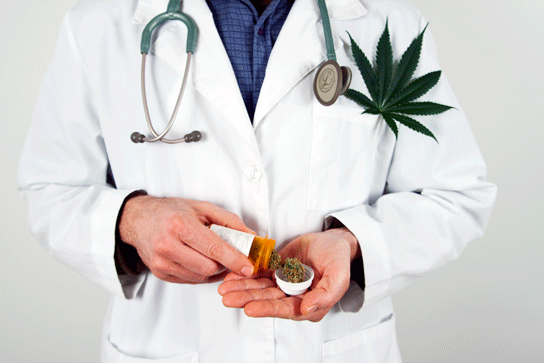
News Moderator: Jacob Redmond 420 MAGAZINE ®
Full Article: Why Medical Marijuana Makes Sense For Chronic Pain, A Doctor’s View
Author: Allie Haroutunian
Contact: Contact Page
Photo Credit: None Found
Website: National Pain Report
Here’s Why The Acting DEA Chief Is Wrong On Medical Marijuana
The acting head of the Drug Enforcement Administration claimed that smoking marijuana has “never been shown to be safe or effective as a medicine.” That’s false: though information is limited on the topic, several studies have found smoked marijuana has medical benefits and mostly mild side effects.
Chuck Rosenberg spoke with reporters on the day that the DEA released its 2015 National Drug Threat Assessment. According to CBS News, he said he is bothered by the idea that marijuana is considered medicinal:
Rosenberg, Nov. 4: “What really bothers me is the notion that marijuana is also medicinal — because it’s not. We can have an intellectually honest debate about whether we should legalize something that is bad and dangerous, but don’t call it medicine — that is a joke. …
There are pieces of marijuana — extracts or constituents or component parts — that have great promise. But if you talk about smoking the leaf of marijuana — which is what people are talking about when they talk about medicinal marijuana — it has never been shown to be safe or effective as a medicine.”
First of all, it is incorrect to suggest that “smoking the leaf of marijuana” is “what people are talking about” with regard to medicinal marijuana. There are approved forms of the drug (or synthetic versions of its compounds) that come in pill form and do not need to be smoked or inhaled.
Secondly, even the smoked form of the drug indeed has been shown to be both safe and effective as a medicine, though only in a limited number of small studies. A review and meta-analysis of medical marijuana studies, published in the Journal of the American Medical Association in June, looked at 79 trials in total, but smoked cannabis was examined in only a few of them. Still, evidence regarding the smoked form of the drug does exist.
For example, one study published in the journal Neurology in 2007 looked at the effect of smoked cannabis on HIV-associated sensory neuropathy, a potentially painful condition affecting nerves in the hands, feet, and other parts of the body. Fifty patients were randomly assigned to either smoke cannabis or placebo cigarettes that looked identical, and were evaluated based on self-reported measures of daily and chronic pain.
After five days, the smoked cannabis reduced daily pain by 34 percent, while placebo only reduced it 17 percent. The very first cannabis cigarette smoked reduced chronic pain substantially, while the first placebo had very little effect. The study also found no serious adverse events were reported during the trial.
A second study, published in 2008 in Neuropsychopharmacology, also found benefit with smoked cannabis for the same medical condition. In this case, 28 patients completed two separate five-day treatment periods, separated by a two-week washout period; in one, they smoked cannabis cigarettes four times daily for five days, and in the other they smoked placebo cigarettes. Pain was evaluated using the Descriptor Differential Scale, which allows patients to use certain words to describe pain intensity; researchers use those descriptions to assign a pain score. The study found that 46 percent of cannabis smokers achieved at least a 30 percent reduction in pain, compared to only 18 percent of placebo smokers.
The side effects again were mostly mild, two patients did experience “treatment-limiting” toxicities. These included one episode of “cannabis-induced psychosis” and one intractable smoking-related cough during cannabis treatment. The symptoms resolved when the treatment was stopped. The authors noted an important point regarding smoked marijuana: “Smoking is not an optimal delivery system. Long-term use of smoked cannabis is associated with symptoms suggestive of obstructive lung disease, and although short-term use is not, many individuals cannot tolerate smoking.”
The beneficial effects of smoked marijuana are not limited to only HIV-associated neuropathy. Another study, published in 2012 in the Canadian Medical Association Journal, looked into its use to control spasticity in 30 patients with multiple sclerosis. This study again had patients experience both actual cannabis cigarettes and a placebo, and it again found more benefit with the cannabis.
In this study, patients had much greater reductions in spasticity with the drug than without it; this was measured using something called the modified Ashworth scale, which is a well-validated tool assigning point values based on muscle tone, range of motion, and other factors. Pain also diminished more, based on the Visual Analog Scale, with cannabis. There were no serious adverse events reported.
Obviously, these studies do not represent a particularly large body of evidence for smoked cannabis. In fact, the JAMA review concluded: “Further studies evaluating cannabis itself are also required because there is very little evidence on the effects and AEs [adverse events] of cannabis.”
Studying medicinal effects of marijuana in general is difficult in the U.S., thanks to its inclusion on the federal list of “schedule 1” drugs. Those drugs, which include heroin, LSD, and a few other dangerous drugs, are “defined as drugs with no currently accepted medical use and a high potential for abuse,” according to the DEA.
However, the JAMA review also specifically noted that at least some such evidence does exist: “[T]here was moderate-quality evidence to suggest that cannabinoids may be beneficial for the treatment of chronic neuropathic or cancer pain (smoked THC and nabiximols).” Nabiximols is a cannabis extract delivered as a mouth spray.
“Very little evidence” is not the same as “never been shown to be safe or effective as a medicine,” as Rosenberg claimed. There is in fact evidence of smoked marijuana’s beneficial effects and safety.

News Moderator: Jacob Redmond 420 MAGAZINE ®
Full Article: DEA Chief Wrong on Medical Marijuana
Author: Dave Levitan
Contact: Email The Editor
Photo Credit: Bloomberg News
Website: Fact Check