Law & Politics
Lawmakers Question Postal Service About Marijuana Ad Threats to Newspapers
A group of members of Congress is demanding the U.S. Postal Service explain a memo it recently issued warning newspapers not to mail any publications containing advertisements for marijuana. “It appears a clarification of USPS policy is needed for state-legal marijuana businesses who seek to mail advertisements, as well as newspapers or periodicals that may run ads from […]
Canada’s Health Minister Studying Marijuana Legalization Models
Canada’s brand new top health official is actively looking into the best way for the country to legalize marijuana.
Minister of Health Jane Philpott, who assumed office a little more than three weeks ago, told the CBC that government scientists are already briefing her on possible legal regulations for cannabis.
“The world is going to be looking to Canada to make sure we do the job well,” she said.
Even though the government doesn’t yet know all the details of how it wants to regulate marijuana, Philpott didn’t hesitate to harshly criticize the current prohibition model.
“I think if any of your viewers, if they ask their teenage children, they can verify for them that [marijuana]is far too accessible. And obviously there’s issues around safety and concentrations that are available in certain products are very dangerous,” she said. “Often the products are not pure, and that’s something that’s a serious health concern for us.”
The health minister told CBC that in order to craft the best possible regulations for cannabis, the government will convene a task force of experts who can apply prior experience with other legal products like tobacco.
Earlier this month, newly sworn-in Prime Minister Justin Trudeau directed Philpott and two other cabinet officials, the minister of public safety and emergency preparedness and the minister of justice, to begin working together to craft a plan to legally regulate marijuana.
Trudeau’s Liberal Party, which won a strong majority in last month’s federal elections, included support for legalization in its official platform. During the campaign, Trudeau pledged to begin work on ending prohibition “right away” if elected.
The Conservative Party, which ruled Canada for nearly a decade prior to the election, regularly attacked Trudeau’s legalization plans during the campaign but declined to respond to a request for comment from CBC about the new government’s moves.
Philpott is confident her department will have the public support it needs to craft and implement an effective marijuana policy. “Most thoughtful Canadians recognize that the current system isn’t working and they’re looking to us to make sure we make a wise decision,” she said.
Lawmakers Push to Reduce DEA Marijuana Eradication Funds
The Drug Enforcement Administration (DEA) is in hot water on Capitol Hill on a number of fronts.
Late last week, for example, a bipartisan group of lawmakers called on President Obama to fire Chuck Rosenberg, the agency’s acting administrator, after he called medical marijuana a “joke.”
And now a group of 12 House members is pushing to take money away from DEA’s efforts to eradicate marijuana plants and devote the savings to programs aimed at preventing child abuse and violence against women.
“The Cannabis Eradication Program’s sole mission is to eradicate marijuana plants and arrest growers. However, historical data indicates that the vast majority of plants seized under this program are wild plants descendant from industrial hemp,” the lawmakers, led by Rep. Ted Lieu (D-CA), wrote in a letter to House Republican and Democratic leaders. “There is no justification for spending this kind of money on an antiquated program never shown to be effective.”
The letter urges Congressional leadership to include the substance of an amendment that Lieu sponsored, which passed the House on a voice vote in June, in the final Fiscal Year 2016 spending package that appropriators from both chambers are now negotiating. The Lieu proposal was one of a series of amendments adopted by the House that, in total, cut $23 million from DEA’s budget and shifted the funds to things like solving the rape kit testing backlog, helping child abuse victims and paying for police body cameras.
Including Lieu’s $9 million shift from DEA would be an “important and needed step forward to cut waste from our federal budget and focus our limited resources on programs [that]have proven to be effective at preventing violence, assisting children who have victimized, and promoting public health,” the lawmakers wrote.
Besides Lieu, other members signing the letter are Reps. Jared Polis (CO), Earl Blumenauer (OR), Steve Cohen (TN), Eric Swalwell (CA), Mark Pocan (WI), Mike Honda (CA), Barbara Lee (CA), Jan Schakowsky (IL(, Raúl Grijalva (AZ), Beto O’Rourke (TX) and Sam Farr (CA). All are Democrats.
Current funding for the federal government runs out on December 11, and leaders from both chambers of Congress are working to finalize a spending package that can earn enough votes to pass before that date.
Lawmakers Tell Obama to Fire DEA Head Over Marijuana Comments
A bipartisan group of members of Congress sent a letter to President Obama on Thursday demanding that he fire DEA head Chuck Rosenberg for calling medical marijuana a “joke.”
Rosenberg’s “statements are indicative of a throwback ideology rooted in the failed War on Drugs,” the lawmakers, led by Rep. Earl Blumenauer (D-OR), wrote. “They do not reflect the overwhelming body of testimonial evidence, reforms happening across the country at the state level and in Congress, or the opinion of the American people – and they certainly don’t reflect statements you’ve made or actions you’ve directed your agencies to take. Rather, these statements demonstrate Mr. Rosenberg is not the right person to lead the DEA.”
The letter follows an impassioned floor speech Blumenauer delivered on Wednesday in which he called Rosenberg “an inept, misinformed zealot who has mismanaged America’s failed policy of marijuana prohibition.”
Joining Blumenauer in signing the new letter are Reps. Dana Rohrabacher (R-CA), Steve Cohen (D-TN), Sam Farr (D-CA), Barbara Lee (D-CA), Ted Lieu (D-CA) and Jim McDermott (D-WA).
They wrote that Rosenberg’s comments “send a clear signal to the American people that the federal government isn’t listening to them. It erodes trust. Cavalier statements like these fly in the face of state policy and the experience of millions of patients. Over 75 percent of the public supports allowing for the use of medical marijuana if recommended by a physician and surveys have found that a majority of physicians also support legalizing medical marijuana.”
The letter comes after nearly 100,000 people signed a Change.org petition decrying Rosenberg’s comments and calling for him to be fired or resign.
“Through his statements, Mr. Rosenberg has demonstrated he is not the right person to hold the job as head of the DEA and we urge you to find new leadership that can work to develop the right tools to properly rationalize our treatment of marijuana,” the members of Congress wrote to the president.
A group of medical marijuana patients has announced that they will deliver printed copies of the petition to DEA headquarters on Friday.
Congressman Demands Change at DEA: Medical Marijuana Is No ‘Joke’
A member of Congress who is leading the fight to reform federal marijuana laws took to the House floor on Wednesday morning and called for the head of President Obama’s top drug war official.
In the speech, Rep. Earl Blumenauer (D-OR) added his voice to tens of thousands of others that have demanded the firing or resignation of Chuck Rosenberg, acting administrator of the Drug Enforcement Administration (DEA), following his description of medical marijuana as a “joke.”
More than 90,000 people have signed a petition demanding Rosenberg’s ouster.
“What is a joke is the job Rosenberg is doing as acting DEA administrator,” Blumenauer said. “He is an example of an inept, misinformed zealot who has mismanaged American’s failed policy of marijuana prohibition.”
The Change.org petition calling for Rosenberg’s firing was uploaded by the organization Marijuana Majority less than two weeks ago and already has more signatures than an earlier one that helped lead to the resignation of previous DEA administrator Michele Leonhart, who also opposed medical marijuana.
(Full disclosure: The author of this article is the founder of Marijuana Majority.)
Rosenberg’s comments are a “throwback ideology rooted in the failed war on drugs, which needs to stop,” Blumenauer said. “This culture needs to change. Leadership needs to change. Rosenberg is clearly not the right fit for the DEA in this administration.”
The congressman has sponsored and signed on to numerous marijuana policy reform proposals, including a measure that would prevent DEA from spending money to interfere with the implementation of state medical marijuana laws. He has also sponsored legislation to allow military veterans to more easily access medical cannabis by working with their doctors at the Department of Veterans Affairs.
“I would hope that the president directs the heads of all relevant agencies to adjust their policies, clarify regulations that deal with marijuana laws, establish policies that reflect changing state laws and, most important, reflect the president’s own position,” Blumenauer said, referring to President Obama’s saying his administration has “bigger fish to fry” than going after low-level marijuana offenders.
“It’s time that the rest of his administration gets on board, and it should start with a new head of” DEA, Blumenauer said.
See video of his floor speech demanding change at the DEA here.
Canada Officially Begins Move Toward Legalizing Marijuana
Canada’s new prime minister was only sworn in less than two weeks ago, but he has already directed his government to begin the process that will lead to the nationwide legalization of marijuana.
“I will expect you to work with your colleagues and through established legislative, regulatory, and Cabinet processes to deliver on your top priorities [including]a federal-provincial-territorial process that will lead to the legalization and regulation of marijuana,” Prime Minster Justin Trudeau wrote to Jody Wilson-Raybould, the country’s new justice minister and attorney general.

The move is in keeping with a campaign pledge to begin formulating a plan to end prohibition “right away.” Support for legalization was also included in the official platform of Trudeau’s Liberal Party, which swept the country’s October 19 federal elections with a strong majority.
It is unclear how long it will take the new government to formulate and enact a system to tax and regulate marijuana, or what its specifics will include, but the early move by Trudeau is an indication he intends to follow through on what he promised during the campaign. Parliament is scheduled to resume on December 3.
Trudeau also directed the health and public safety and emergency preparedness ministers to assist Wilson-Raybould in formulating the plan for legal marijuana in separate letters made public on Friday.
As Canada moves forward with legalization to the U.S.’s north, marijuana reform is also on the rise south of the border, in Mexico. The Supreme Court there ruled earlier this month that growing cannabis for personal use and distribution should be a right. While the ruling only currently applies to the four plaintiffs who brought the case, it has caused shockwaves around the world and could ultimately lead to nationwide legalization if the court takes up additional cases and rules similarly. Separately, last week, a senator from the country’s ruling party introduced a bill to legalize the importation of medical marijuana.
And the U.S. is just fine with these moves, according to a State Department official. “It’s up to the people of each nation to decide policies,” John Kirby, a spokesman for the U.S. Department of State, said at a press conference in response to questions about the growing marijuana reform momentum in Canada and Mexico.
Within U.S. borders, marijuana is currently legal in four states and the District of Columbia. It is expected that at least five other states will vote on ballot measures to end marijuana prohibition next November, and advocates believe that a handful of state legislatures could enact legalization even sooner.
State Department: Canada and Mexico Can Legalize Marijuana If They Want
Signaling a continued shift in U.S. posture toward drug policy reform in other countries, a federal official said on Thursday that Canada and Mexico should be able to legalize marijuana if they want to.
“It’s up to the people of each nation to decide policies,” John Kirby, a spokesman for the U.S. Department of State, said in a press briefing. “And in this case, it’s up to the people of Mexico to decide which drug policies are most appropriate for their country within the framework of international law.”
Kirby was responding to a journalist who asked about a Mexican Supreme Court ruling on Wednesday which could result in the legalization of marijuana. The reporter also cited the swearing in this week of new Canadian Prime Minister Justin Trudeau, who pledged during his election campaign to end cannabis prohibition “right away” after taking office.
Historically, the U.S. has pressured other countries to maintain a prohibitionist approach under international drug control treaties. But under the Obama administration, as voters in a growing number of U.S. states have legalized marijuana within the nation’s own borders, the State Department has taken a more respectful approach based on an evolving interpretation of the treaties which sees flexibility for countries to move away from prohibition.
Referring to those treaties, Kirby said that the U.S. is “firmly committed to the three UN drug conventions,” adding that they are “the foundation of international cooperation for dealing with all aspects of the drug problem.”
He noted the U.S.’s view that “the conventions allow for a degree of flexibility on how member-states implement their obligations, particularly with respect to drug use, and the conventions anticipate variations in national legal frameworks.”
The remarks are in line with what other top State officials have said in the recent past, but are particularly notable in the context of the recent big moves happening both north and south of the U.S.’s borders.
Last year, William Brownfield, the assistant Secretary of State for the Bureau of International Narcotics and Law Enforcement Affairs said, “The first of [the drug control treaties]was drafted and enacted in 1961. Things have changed since 1961. We must have enough flexibility to allow us to incorporate those changes into our policies.”
He asked, “How could I, a representative of the government of the United States of America, be intolerant of a government that permits any experimentation with legalization of marijuana if two of the 50 states of the United States of America have chosen to walk down that road?”
(Those remarks were made before Alaska, Oregon and Washington, D.C. joined Colorado and Washington State in voting to legalize marijuana.)
In separate remarks earlier this year, Brownfield, referring to Jamaica’s move to decriminalize marijuana, said “we must have tolerance and accept that different countries will address their drug issues in different ways so long as they are committed to the fundamental purposes of [international drug control treaties]and that is to reduce the damage, to reduce the harm and eventually to reduce the abuse of these products.”
The State Department’s increasingly respectful view of drug policy reform abroad clearly stems from U.S. voters in a growing number of states forcing the issue by enacting change at the ballot box: If the U.S. can’t keep legal marijuana out of its own backyard, how can federal officials, with a straight face, tell other nations that they can’t end prohibition too?
The growing boldness of international leaders to champion moves away from the war on drugs is itself spurred by a realization that the U.S. apparently will no longer dangle threats to withdraw foreign aid, for example, in front of other nations that want to enact reforms.
And the fact that Canada and Mexico are now seriously moving toward legalizing marijuana is itself likely to bolster efforts to legalize marijuana in even more U.S. states.
All of these factors have created a feedback loop of sorts where each new jurisdiction that enacts reform propels efforts in nearby places, to the point where marijuana may be legal across all of North America (and perhaps beyond) way before many observers thought would be possible.
New DEA Report Has Lots of Goodies for Marijuana Reformers
A new report from the Drug Enforcement Administration (DEA) contains a number of tidbits that will make marijuana law reform supporters variously cheer, giggle or scratch their heads.
First off, the National Drug Threat Assessment, an annual publication, says it lists drugs “in ranking order based on the level of threat each drug presents.” But it puts marijuana ahead of synthetic drugs and PCP.
Next up, noting that “80 percent of states have approved some form of medical marijuana,” the document includes a helpful map showing just how badly DEA and other prohibitionists are losing the state-by-state political debate on cannabis:

The 148-page report, released on Wednesday, includes input from 1,105 state and local law enforcement agencies across the country. As The Washington Post’s Chris Ingraham points out, the survey data those cops submitted to DEA shows that they don’t see marijuana as a big threat relative to other drugs, despite the fact that most of the drug arrests their departments make are focused on cannabis:

Chart via Washington Post
In a very clear sign of the failure of widespread prohibition to keep drugs away from kids, the report admits that “marijuana use continues to exceed tobacco use” among high school students. Whereas the cartels and gangs that control the illegal marijuana market in 46 states don’t ask customers for I.D., reform advocates argue, legal tobacco merchants are highly incentivized to make sure they people they sell to are of legal age lest they be fined or lose their lucrative business licenses.
The document also contains a sidebar on social media and lists hashtags like #420, #710, #BHO and#dabs:

Most importantly from a policy perspective, the report contains several passages showing the real impact that the marijuana law reform movement’s success has had on DEA’s ability to chop down cannabis plants and arrest and jail the people who grow them.
DEA-led cannabis eradication in California is down 64%, which the report says is partly caused by a “shift in enforcement priorities due to state-approved marijuana” laws.
“The number of arrests in domestically-produced marijuana investigations has also declined,” DEA adds. “This decline in marijuana arrests, in particular those for domestic marijuana, and marijuana cases is due in part to state-approved marijuana measures.”
The document also includes these charts showing a dramatic decline in the number of cannabis cultivation sites and plants DEA has been able eradicate over the past five years as more state marijuana laws have come online and as the national political climate has become much more opposed to outright prohibition and its enforcement:

And the report notes that “domestic legalization initiatives” could be cause of a big decline in the amount of marijuana being smuggled over the border from Mexico:
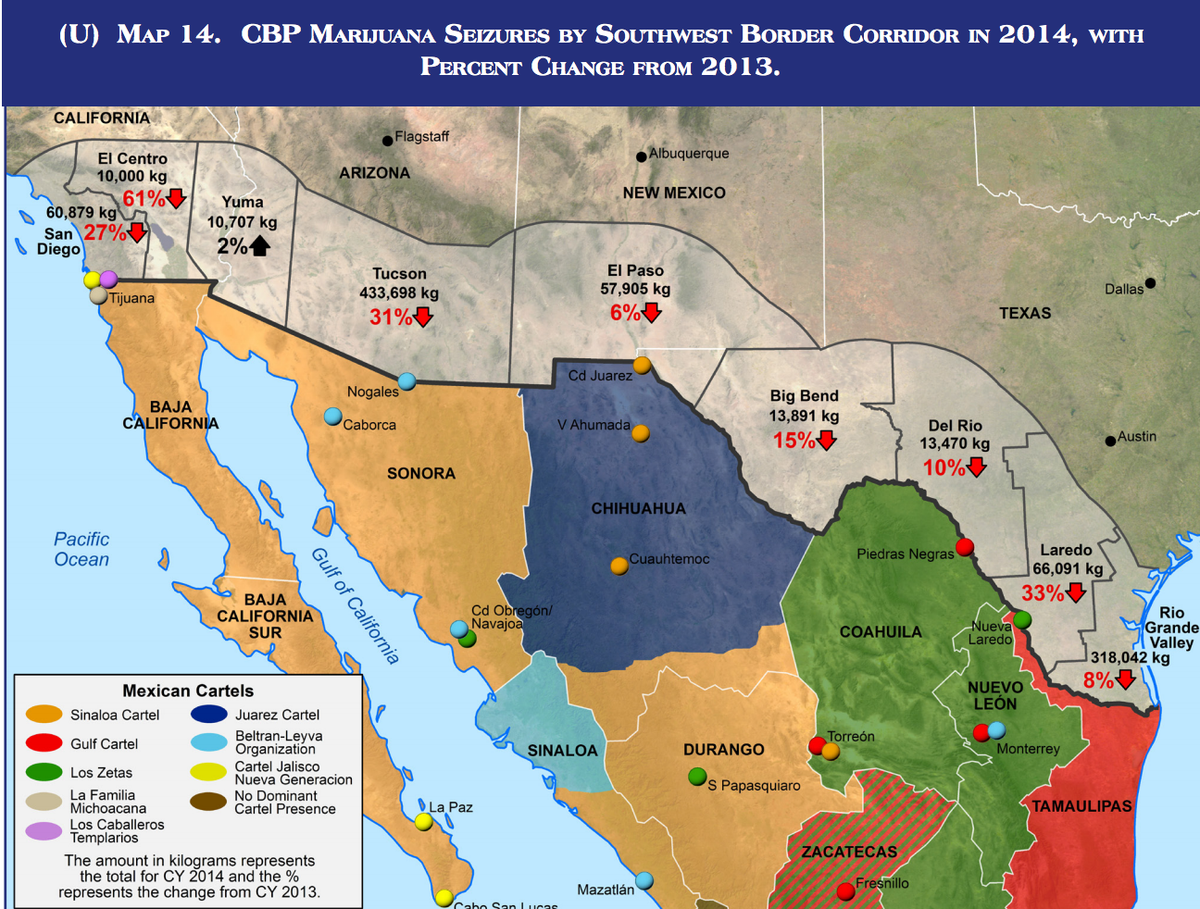
But make no mistake: Despite the damning evidence against prohibition’s effectiveness, DEA isn’t about to endorse legalization. The report even goes out of its way to make sure readers understand the agency doesn’t think medical marijuana is an actual thing.
“When the term ‘medical marijuana’ is used in this publication, it is exclusively in reference to state-approved ‘medical marijuana,’” a footnote says. “Marijuana is a Schedule I substance under the Controlled Substance Act with no accepted medical use in the
United States.”
Separately, in a briefing with reporters on Wednesday, DEA Acting Administrator Chuck Rosenberg argued that medical marijuana is a “joke.”
“What really bothers me is the notion that marijuana is also medicinal — because it’s not,” Rosenberg said. “We can have an intellectually honest debate about whether we should legalize something that is bad and dangerous, but don’t call it medicine.”
Despite the increasing latitude the Justice Department has given states to implement their own marijuana laws without much federal interference during President Obama’s second term, it appears the drug warriors at DEA are still not happy about it.
Justin Trudeau and Marijuana: Like Father, Like Son
The recent victory in Canada by Justin Trudeau and his Liberal Party, a landslide triumph that ended nearly a decade of rule by the Conservative Party, promises a significant change in the politics of Canada in a number of policy areas, including a boost in spending to stimulate the economy; raising taxes on the wealthy; and legalizing marijuana.
Stephen Harper, head of the Conservative Party, attempted to use marijuana legalization as a wedge issue against Trudeau in the recent campaign, making the rather bizarre claim that marijuana is “infinitely worse” than tobacco (an estimated 37,000 Canadians die each year from tobacco smoking). His allegation fell flat with the voters and likely helped Trudeau demonstrate the need for new, fresh and more innovative and honest leadership.
Trudeau has long favored the legalization of marijuana, publicly acknowledging his own past use of weed (including an admission of smoking when he was a member of Parliament). Shortly after the recent Liberal Party victory, he announced legalization would move forward as one of his top priorities. We share a common border stretching nearly 4,000 miles, and whatever occurs in the U.S. inevitably has an impact on Canada. It appears our domestic experience with marijuana legalization has favorably impacted attitudes in Canada, and they too are now ready for a tax and regulate regimen.
The First Prime Minister Trudeau
This needed change in Canadian marijuana policy reminds some of us of earlier times when Canada had a far more progressive and tolerant marijuana policy than the U.S., going back to the 1960s and 1970s, when Justin Trudeau’s father, Pierre Trudeau, was the Prime Minister. Pierre Trudeau served as prime minister from 1968 to 1979, and again from 1980 to 1984. He was a dominant political presence who, with his glamorous wife Margaret Trudeau, was part of the fast-lane crowd during the 1970s, famously partying with the Rolling Stones; hanging-out at then-popular Studio 54 in New York; and, in a strange moment in a Washington Post news article, once publicly invited disillusioned young Americans to visit Canada, promising they would not be harassed if they brought along a couple of joints.
This was during the height of the anti-Vietnam War movement, when young Americans burning their draft cards and long hair and marijuana smoking were all part of the cultural rebellion that would transform American society and eventually bring that war to an end. Canada, and Pierre Trudeau, were generally opposed to the war, and supportive of U.S. draft resisters (offering them asylum in Canada) and others who were working to stop the killing.
Raising the “Pierre Trudeau Defense”
It was this public invitation to visit Canada that led me to raise the “Pierre Trudeau defense,” when I was busted with a joint entering Canada to give a college lecture in Calgary in the mid-1970s.
I was (obviously) not familiar with the rigors of international travel at the time, and had stuck a joint in the pocket of my sports coat to share with the students when the lecture was over. We usually went back to someone’s apartment after a college lecture, where the students would generally pass around a joint of whatever weed was available on the black market, at prices most students could afford, and frequently it was not high quality – what we might call “ditch weed” today. So I always enjoyed bringing a joint from my own stash – high quality homegrown – to share with the students, to let them experience the better marijuana that was available if one had the right connections on the black market.
As further evidence of my naiveté, I also was wearing a gold marijuana-leaf lapel pin on my sports coat, oblivious to the fact that the marijuana pin might well bring closer scrutiny as I entered the county. I almost made it through Customs without a problem, but at the last minute, one of the officers recognized my pin, and decided to stop me and search my pockets, where he found the joint.
As I was being taken into custody, a group of the students who were meeting me to take me to the lecture saw what was happening, and someone had the good sense to bring the lecture fee that I would have received, to use as bail, so I could get out of custody and deliver the lecture on schedule later that night.
When I returned in a few weeks to go to trial, my old friend Gerry Goldstein, a young Texas criminal defense attorney who was then heading Texas NORML, accompanied me as my attorney. Since we knew possession of a single joint in Canada would bring, at most, a slap on the wrist and a modest fine, we decided to engage in some street theater, and to make it into a show trial, at which we put on the “Pierre Trudeau defense”.
I was never quite sure why Trudeau had made that statement. Perhaps he simply wanted to demonstrate how hip he and his wife were, since they were known to have smoked marijuana with the Rolling Stones at some point. Regardless, it sure sounded like something that might help me justify my actions in Canada, and it would surely make good theater for the media.
So attorney Goldstein first introduced a copy of the Washington Post article into evidence, and then had me take the stand, and under oath, say I admitted bringing the joint into Canada, but insisting that I had done it on the reliance that Prime Minister Pierre Trudeau had assured me (and other young Americans) that we would not be hassled.
It was obviously not a legal defense, but it did have a certain appeal to the media, and seemed to further NORML’s position that there is nothing wrong with smoking pot.
The judge saw the humor in what we were doing, and allowed us to put on our defense, but then convicted me (on my own testimony), imposed a modest fine, and sent me on my way home, none the worse for wear. It had been exhilarating to challenge the system, and we felt we had successfully pushed the policy envelope by being so out-front and unapologetic about my marijuana smoking.
Busted Again, On the Way Out of the Country
But then things turned ugly. On our way through customs as we were leaving the country, still beaming from the fact that we had pulled-off our legal street theater without harm, the Canadian customs officials found an empty one-gram cocaine vial which I had inadvertently left in my shoulder bag, with trace amounts of cocaine still in the bottle, and I was taken back into custody. Suddenly, this little Canadian joke did not seem so humorous, and especially not to the prosecutor or the judge who had just allowed us to pull-off our stunt in his courtroom.
I was thrown in jail overnight, and the following morning Goldstein arranged for me to plead guilty to the new cocaine charge, pay a larger fine, and finally get out of the country, with a warning that I would never be permitted back into the country. (In fact, I have since been back to Canada on several occasions, so apparently someone saw fit to remove me from the list of banned travelers at some point.)
But all these many years later, when I hear the name Trudeau as the newly elected Prime Minister of Canada, I cannot help but smile as I remember the good-old-days, when a combination of youth and naiveté allowed us to live close to the edge, with little or no fear of the consequences.
Today I lead a far less dangerous lifestyle!
Bernie Sanders Pledges to Reform Federal Marijuana Laws
U.S. Senator Bernie Sanders, a candidate for the Democratic presidential nomination, just endorsed ending the federal criminalization of marijuana.
“Right now, marijuana is listed by the federal government as a Schedule I drug—meaning that it is considered to be as dangerous as heroin. That is absurd,” Sanders said at a rally with a large group of college students on Wednesday night.
“In my view, the time is long overdue for us to remove the federal prohibition on marijuana,” he continued. “In my view, states should have the right to regulate marijuana the same way that state and local laws now govern the sale of alcohol and tobacco. And among other things, that means that recognized businesses in states that have legalized marijuana should be fully able to use the banking system without fear of federal prosecution.”
If Sanders turns his campaign proposal into legislation, it will mark the first time in history that a bill to end federal marijuana prohibition has been introduced in the U.S. Senate.
Dan Riffle, a Congressional lobbyist for the Marijuana Policy Project, said on Twitter that legislation is coming, and that it will look similar to a 2011 House bill which would have exempted marijuana from the Controlled Substances Act except for maintaining a prohibition on transporting or shipping the drug to places that have not legalized it.
@_cingraham @germanrlopez His bill will look a lot like this: https://t.co/N8JGVN3a2C Possibly identical.
— Dan Riffle (@DanRiffle) October 28, 2015
“In 2015, it is time for the federal government to let states go forward as they best choose,” Sanders said at the rally. “It is time to tax and regulate marijuana like alcohol. It is time to end the arrests of so many people and the destruction of so many lives for possessing marijuana.”
Earlier this month, Sanders made history at CNN’s Democratic debate by becoming the first major presidential candidate to indicate that he would personally vote for a legalization ballot measure if given the chance.
The time is long overdue for us to take marijuana off the federal government’s list of outlawed drugs.
— Bernie Sanders (@SenSanders) October 29, 2015
Sanders’s campaign also launched a marijuana petition on its website on Wednesday, indicating that top strategists surrounding the candidate see the inherent list-building and fundraising value in taking on a strong, visible leadership role on the issue.
Click here to find out what else Bernie Sanders and other presidential candidates have said about marijuana.