Marijuana News
Florida Sprouts 5 Medical Marijuana Cultivation Sites
Medical marijuana is beginning to take root in Central Florida –– and it’s about time.
After nearly a year of compromise and much legal wrangling in the Sunshine State, the Department of Health has finally designated the five nurseries allowed to produce and dispense a non-psychoactive form of medical marijuana. The long-overdue decision has finally pushed Florida’s reluctant politicians into implementing the 2014 voter approved legislation. Allowing for the cultivation, extraction, and distribution of low THC marijuana concentrates that are high in cannabidiol, or CBD.
Florida’s 2014 medical marijuana law initially passed as a means of helping patients suffering with epilepsy and life-threatening cases of advanced cancer. To qualify for the high-CBD marijuana recommendation, patients should apply to the Compassionate Use Registry once evaluated and diagnosed by a board-certified doctor.
Florida’s 5 New Medical Marijuana Cultivators
- Costa Nursery Farms – Southeast Region.
- Alpha Foliage – Southwest Region.
- Knox Nursery – Central Region.
- Hackney Nursery – Northwest Region.
- Chestnut Hill Tree Farm – Northeast Region.
Florida’s sick and suffering were theoretically to already have access to the high-CBD strains beginning Jan. 1, when physicians that participated in special training were anticipated to start ordering their low-THC marijuana. Unfortunately, that timeline was pushed back due to complicated lawsuits and a judge’s assessment that rejected the Department of Health’s first attempt at fulfilling the will of the people… and the law.
Moving forward, new medical marijuana legislation is slowly making its way through the political process. Provided Florida’s House and Senate wake up and smell the cannabinoids, the passage of Florida’s newest legislation would expand the patient base by allowing for more medical conditions to be covered under the “right to try” state law.
Sarah Palin Agrees: Marijuana Legalization Is “No Big Deal”
Sure, Sarah Palin’s belief that Obama loves to wear mom jeans while Putin spends his free time wrestling bears in Russia’s outback might seem slightly weird to some, but her solid support of marijuana legalization demonstrates that even the strangest among us have moments of clarity.
While speaking with Hugh Hewitt on his conservative talk show, the one time GOP vice presidential nominee and past Alaskan governor noted, “I look on the national scene and think, wow, of all things to be fighting over and battling over, especially when it comes to medical marijuana. I think, hmm, this is just not my baby,”
In a stark departure with many in the Grand Old Party who’ve long supported marijuana prohibition, the “Going Rogue” author yesterday told Mr. Hewitt of marijuana legalization… it’s “no big deal.”
Seemingly stunned by the new reality, Hewitt articulated disbelief that The Last Frontier actually legalized recreational marijuana in 2014; noting the vote “didn’t surprise me.” Me either.
“We’ve got that libertarian streak in us.” As do most…
Read the full interview on HughHewitt.com
(Photo Courtesy of Marijuana Majority)
New York: Looking to Expedite Their Medical Marijuana Program, Gov. Como Signs 2 Emergency Bills
Hoping to kick their MMJ program into high gear, on Wednesday Gov. Cuomo signed two new “emergency medical marijuana” bills into effect. The chronic new legislation is meant to help establish and expedite the distribution of medical marijuana to qualified patients throughout New York State.
On June 15, 2015 the New York legislature gave Assembly Bill 7060 and Senate Bill 5086 their unequivocal support; the passage of these two bills mandates that politicians in the Empire State are to create a new emergency medical marijuana program, thereby expediting the designation and distribution of medical marijuana to those critically ill patients.

New York Gov. signs medical marijuana legislation
Thankfully, Governor Cuomo signed on the dotted line … just a few short hours before the midnight deadline.
According to the Drug Policy Alliance, “After months of pressure from patients and advocates, Gov. Cuomo signed a bill today that will expedite access to medical marijuana for critically ill patients. In June, with overwhelming bipartisan support, both houses of the legislature passed A.7060 (Gottfried) / S.5086 (Griffo), directing the state to establish a program to help critically ill patients obtain emergency access to medical marijuana as soon as possible.”
While many are hopeful that New York’s medical marijuana program will roll out on time, becoming operational by January of 2016, there are serious concerns among some the program will fail to fire up as originally scheduled. As yet, New York’s political heavy hitters have yet to cultivate a realistic system for medical marijuana patients to register – let alone receive their meds.
Per the DPA, many received this announcement as nothing short of a lifesaver:
“I am so very relieved that Governor Cuomo has signed this bill,” explained Missy Miller of Atlantic Beach, whose son Oliver suffers from life-threatening seizures. “I once again have hope that I will be able to offer my son the chance at significant relief. This gives Oliver and the truly sickest patients across NY the opportunity to get access to medical marijuana expeditiously, thereby relieving suffering. This has been an incredibly long and difficult process, but I have renewed faith in my home state. This will become real to me when Oliver gets the medicine he needs.”
High, NYC
Unfortunately, the potential failure of New York’s MMJ program is a real concern for many. Thus far, the Empire State has struggled with the simple implementation of the Health Department’s online training course for doctors hoping to offer recommendations to the sick and suffering. As if that’s not enough to worry about, New York’s medical marijuana supporters are also concerned that none of the state’s designated dispensaries will be ready to start selling their meds by January 1, 2016.
Oregon: 50K Residents Qualify To Have Marijuana Offenses Removed From Their Criminal Record
Thanks to the recent implementation of a novel provision in Oregon’s Senate Bill 844, more than 50,000 residents can now apply to a new program that permits some offenders to expunge marijuana-related crimes from their criminal history.

Oregon’s expungement program
That’s right, according to the Oregon Cannabis Association, the Beaver State’s sweet new piece of legislation allows those with past marijuana-related indiscretions – including cultivation and distribution – to have their past improprieties purged from their permanent criminal record. Thereby making it easier for those convicted of past marijuana related crimes to find gainful employment.
In order to qualify for Oregon’s expungement program, there are a few criteria that must first be met:
1.) Those petitioning to have marijuana offenses sealed from their permanent record must wait 12 months from their last conviction.
2.) All fines and restitution must be paid, the petitioner should be off probation or parole and have completed all terms and conditions of their sentence.
3.) Petitioners may have no other conviction, excluding motor vehicle violations, within the past 10 years. And those currently charged with a marijuana related crime, need not apply.

Contact the circuit court of the county in which you were convicted
To get your past marijuana conviction sealed in Oregon, contact the circuit court of the county in which you were convicted. Currently Oregon charges $252 for these expungement requests. Additionally, the Oregon State Police charges $80 for their fingerprinting service – a requirement of SB 844. Caveat: Depending on the county you live in, other charges may apply.
Lear more about Oregon marijuana laws
Higher Learning: Pueblo County Pays For College Scholarships With New Marijuana Tax
Canada’s new Prime Minister has promised to legalize it; Mexico’s Supreme Court has just ruled their citizens have a constitutional right to smoke it; and starting in 2017, those college-bound from Pueblo County will be able to get their college degrees partially funded by it. – How sweet “It” is. Providing more positive results in the Petri dish of democracy, Colorado’s newest and greenest cash cow is about to help America’s next generation of critical thinkers pay for college.
That’s right; last Tuesday legalized pot vaporized another concern for some of Colorado’s high school graduates hoping to head off to college – we’re talking about cold hard cash. Thanks to Colorado’s early ascension up the Darwinian ladder of social evolution, students from Pueblo County hoping to become doctors, lawyers, MBAs, and politicians, will all have the ability to save a big chunk of green on their college degree. #ThanksAgainLegalMarijuana

According to CNN, “a resounding 60% of the voters in the tiny County of Pueblo Colorado passed a measure that will phase in an increase in taxes — 5% by 2020 — on marijuana growers to fund college scholarships and other community projects. “
While Bernie and Hillary debate the abstract benefits of legalizing marijuana at the federal level, Colorado, Washington, Oregon, Alaska, and Washington DC have been putting the theoretical Rubber to the Road. Providing valuable proof that legalized marijuana reduces crime, generates useful new tax revenue, and protects our kid’s intellectual potential from being flushed down the drain of bad policy gone predictably wrong.
Read more on CNN
New DEA Report Has Lots of Goodies for Marijuana Reformers
A new report from the Drug Enforcement Administration (DEA) contains a number of tidbits that will make marijuana law reform supporters variously cheer, giggle or scratch their heads.
First off, the National Drug Threat Assessment, an annual publication, says it lists drugs “in ranking order based on the level of threat each drug presents.” But it puts marijuana ahead of synthetic drugs and PCP.
Next up, noting that “80 percent of states have approved some form of medical marijuana,” the document includes a helpful map showing just how badly DEA and other prohibitionists are losing the state-by-state political debate on cannabis:

The 148-page report, released on Wednesday, includes input from 1,105 state and local law enforcement agencies across the country. As The Washington Post’s Chris Ingraham points out, the survey data those cops submitted to DEA shows that they don’t see marijuana as a big threat relative to other drugs, despite the fact that most of the drug arrests their departments make are focused on cannabis:

Chart via Washington Post
In a very clear sign of the failure of widespread prohibition to keep drugs away from kids, the report admits that “marijuana use continues to exceed tobacco use” among high school students. Whereas the cartels and gangs that control the illegal marijuana market in 46 states don’t ask customers for I.D., reform advocates argue, legal tobacco merchants are highly incentivized to make sure they people they sell to are of legal age lest they be fined or lose their lucrative business licenses.
The document also contains a sidebar on social media and lists hashtags like #420, #710, #BHO and#dabs:

Most importantly from a policy perspective, the report contains several passages showing the real impact that the marijuana law reform movement’s success has had on DEA’s ability to chop down cannabis plants and arrest and jail the people who grow them.
DEA-led cannabis eradication in California is down 64%, which the report says is partly caused by a “shift in enforcement priorities due to state-approved marijuana” laws.
“The number of arrests in domestically-produced marijuana investigations has also declined,” DEA adds. “This decline in marijuana arrests, in particular those for domestic marijuana, and marijuana cases is due in part to state-approved marijuana measures.”
The document also includes these charts showing a dramatic decline in the number of cannabis cultivation sites and plants DEA has been able eradicate over the past five years as more state marijuana laws have come online and as the national political climate has become much more opposed to outright prohibition and its enforcement:

And the report notes that “domestic legalization initiatives” could be cause of a big decline in the amount of marijuana being smuggled over the border from Mexico:
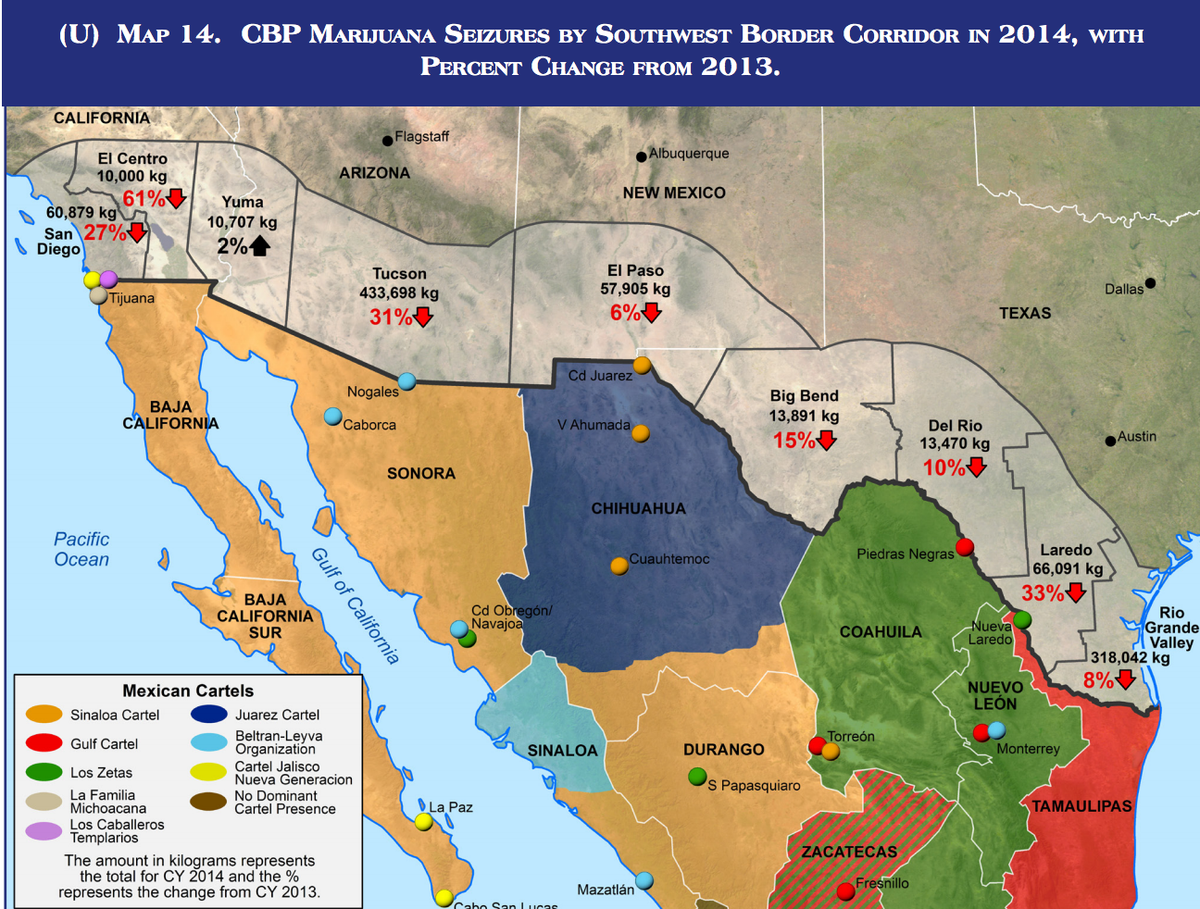
But make no mistake: Despite the damning evidence against prohibition’s effectiveness, DEA isn’t about to endorse legalization. The report even goes out of its way to make sure readers understand the agency doesn’t think medical marijuana is an actual thing.
“When the term ‘medical marijuana’ is used in this publication, it is exclusively in reference to state-approved ‘medical marijuana,’” a footnote says. “Marijuana is a Schedule I substance under the Controlled Substance Act with no accepted medical use in the
United States.”
Separately, in a briefing with reporters on Wednesday, DEA Acting Administrator Chuck Rosenberg argued that medical marijuana is a “joke.”
“What really bothers me is the notion that marijuana is also medicinal — because it’s not,” Rosenberg said. “We can have an intellectually honest debate about whether we should legalize something that is bad and dangerous, but don’t call it medicine.”
Despite the increasing latitude the Justice Department has given states to implement their own marijuana laws without much federal interference during President Obama’s second term, it appears the drug warriors at DEA are still not happy about it.
Mexico’s Supreme Court Green Lights Pathway Towards Legalization
Sure to upset Mexico’s Sinaloa drug cartel and “El Chapo” Guzmán, yesterday was a great day for supporters of medical marijuana and those who support the outright legalization of pot south of the border.
On Wednesday, Mexico’s Supreme Court decided that prohibiting the cultivation and consumption of marijuana for personal use was unconstitutional. Potentially setting in motion the legalization of marijuana in Mexico. In a legal ruling handed down on Wednesday, Justice Arturo Zaldívar authored an 88-page decision based on the principles of human rights – reasoning that Mexico acknowledges an individual’s freedom to participate in activities…provided they don’t harm others.
That’s right, Mexico’s highest court has now decided that prohibiting individuals from smoking weed or growing it for their own personal use violates an individual’s human rights, according to the New York Times.
“The vote by the court’s criminal chamber declared that individuals should have the right to grow and distribute marijuana for their personal use. While the ruling does not strike down current drug laws, it lays the groundwork for a wave of legal actions that could ultimately rewrite them.”

Mexico’s Supreme Court Green Lights Pathway Towards Legalization
Leaving in place the existing marijuana laws for now, the court’s ruling only applies to the cannabis club that filed a lawsuit on behalf of an eight-year-old girl known as “Grace,” who became Mexico’s first medical marijuana patient in 2015.
With the court’s new ruling in hand, many in Latin America are hoping this decision will spark an important debate on South America’s overly conservative drug laws – kicking open the door for similar challenges to Mexico’s marijuana laws.
Wednesday’s ruling represents the culmination of a tireless effort from the good people at Mexico’s United Against Crime.
<center
Ohio Voters Snuff Out Issue 3
Seemingly more fearful of the proposed marijuana monopoly than of being arrested for pot – Ohio’s voters have snuffed out Issue 3, putting down like a rabid animal the ballot measure that would have legalized both recreational and medical marijuana for adults over the age of 21.
Trounced by a resounding 34.8% to 65.1%, the unofficial election results clearly demonstrated Ohio’s rejection of the proposed legalization framework. Comprised of a network of 10 cultivation facilities, many feel the proposed monopoly killed the optimistic polling numbers heading into the election.
Despite an October Quinnipiac poll that had shown 53% of Ohio’s voters were down with legalizing marijuana, the majority ultimately decided that Issue 3 was an ugly initiative that needed to be put out of its misery. Blaming the painful loss on the initiative’s proposed monopoly, voters like Katie Kauffeld told USA Today:
“I don’t have a problem with the legalization of marijuana, I have a problem with the monopoly and the way this particular amendment was written up…
While the rejection of Issue 3 smells like failure from a distance – it actually represents a thoughtful step forward. Rather than accepting legalization at any cost, Ohio’s voters have instead opted to wait for the right ballot initiative; hopefully putting the hot topic high on the To Do List for the Ohio state legislature going forward.
Ohio Votes To Legalize Recreational Pot Today: Will Nick Lachey Become A Marijuana Kingpin?
As one of the backers of marijuana legalization in The Buckeye State, Nick Lachey could go from ex-boy-bander to marijuana kingpin in just 24 hours– provided Ohio’s Issue 3 passes.

Nick Lachey wants recreational marijuana legalized in Ohio
That’s right it’s Election Day – Tuesday, November 3rd – and in Ohio, supporters and opponents alike will have the opportunity to vote on the highly volatile topic of marijuana legalization. If passed, Ohio would be the fifth state to legalize the consumption, cultivation and distribution of recreational marijuana in the United States.
Unfortunately, the wait for a final tally on today’s vote might be an agonizing one for Ohio’s constituents. Despite working towards this critical moment for years, the vote still remains too close to call. In other words, the voting public could be kept in the dark until well-after the polls close tonight at 8:00 pm Eastern time.
Learn more about marijuana legalization in Ohio
If passed by Ohio’s constituents, Issue 3 would legalize the personal possession of up to an ounce of marijuana for those over the age of 21, and up to 8 Oz’s for those licensed by the state. As to the fortunate few who are granted an Ohio cultivation license, they’ll be able to germinate an unlimited number of marijuana seedlings, and cultivate up to four mature females.
Brick-and-mortar marijuana shops will also be permitted under Issue 3, which is where the ex-boybander comes in. Provided Issue 3 passes, Nick and his new group of friendly investors will be supplying Ohio pot smokers their freshly legalized marijuana, as promised by the controversial initiative.
While there’s little doubt this contentious and highly debated stipulation represents a serious sticking point for Issue 3, its passage would clearly represent a breathtaking conquest for those hard fighting marijuana reformers and fans of civil liberty.
(Photo Courtesy of WKBN)
Update: Industrial Hemp Cultivation Is Finally Legal In North Carolina
October 31 has finally come and the Fat Lady has begun to sing – belching out a loud and proud ditty for a lot of soon-to-be hemp farmers in North Carolina. Thanks to Gov. Pat McCrory’s long ignored veto stamp, the hemp bill left behind on his desk when the N.C. General Assembly headed off for vacation last month … just became law.
While some politicians will hear the Fat Lady’s song and call hemp’s freedom in North Carolina a hateful noise, even though they love the idea of a new cash crop. The fact of the matter remains; the campaign to legalize hemp in North Carolina is effectively over … and HEMP WON!
Thanks to either the Gov.’s apathy or an epiphany, the passage of North Carolina’s industrial hemp legislation will put them in a rather exclusive club. Joining the other 13 states that have already established a commercial industrial hemp program, and seven that have passed laws establishing hemp programs limited to academic and agricultural research.